
Prophet Musa (AS): The Story of Courage, Divine Speech, and Liberation
Have you ever felt tiny standing before a massive problem? Have you ever had to speak the truth to someone powerful, while your heart was racing with fear?
When Muslims look for the ultimate example of raw courage, speaking truth to power, and the absolute victory of justice over tyranny, they look directly to Prophet Musa (AS) (Moses).
Prophet Musa (AS) is the most frequently mentioned Prophet in the Holy Quran, appearing by name 136 times. His life was an epic journey filled with dramatic turning points—from being a baby floating in a basket on the Nile, to growing up in the palace of his enemy, to physically splitting the sea. His legacy is a masterclass in how a human being can overcome deep-seated anxieties by anchoring themselves to the speech and protection of Allah.
Who Was Prophet Musa (AS)?
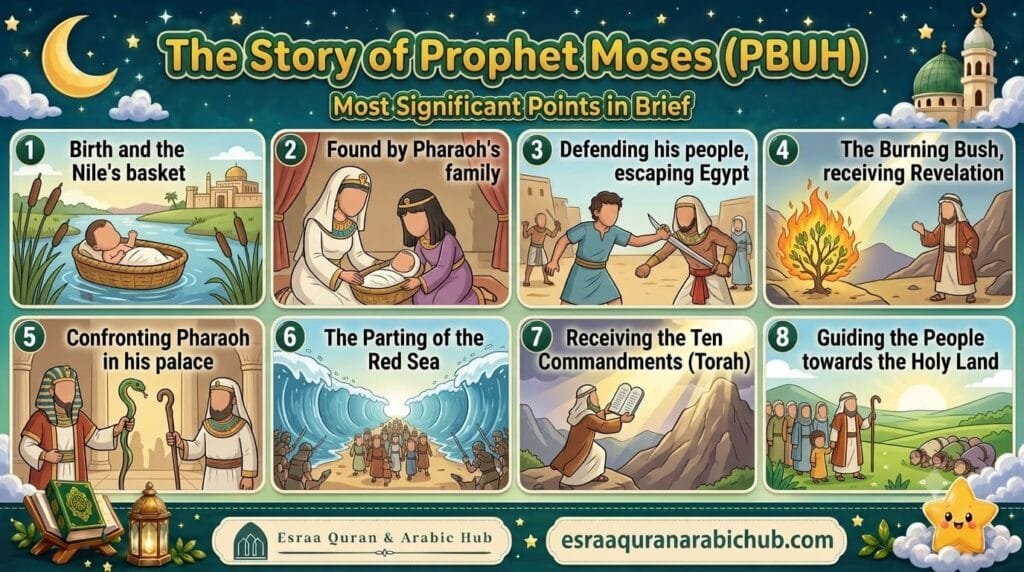
Prophet Musa (AS) was born into the noble lineage of Bani Israel (The Children of Israel) during a dark period in ancient Egypt. Egypt was ruled by the ultimate tyrant: Pharaoh (Fir’awn), an arrogant dictator who enslaved Bani Israel, treated them with brutal cruelty, and decreed that every newborn male child among them must be put to death.
To save her newborn baby, Musa’s mother received a divine inspiration from Allah to do something that defied all human logic: place her tiny infant in a wooden basket and cast him into the strong currents of the Nile River.
Why Is Prophet Musa (AS) Unique in Islam?
Prophet Musa (AS) holds an extraordinary rank among the Ulul ‘Azm (the five Messengers of Strong Will). He is uniquely honored with the sacred title Kalimullah—The One with Whom Allah Spoke Directly.
Unlike other prophets who received revelation through the Angel Jibril (Gabriel), Allah chose to speak directly to Musa (AS) on the sacred mount of Toor in Sinai. This direct dialogue infused Musa with an unbreakable inner strength that allowed him to stand firm against the most powerful empire of his era.
The Core Concept: Overcoming Fear Through Reliance (Tawakkul)
Musa’s life was a continuous series of high-stakes confrontations, and the Quran does not hide his human vulnerability. Musa famously experienced fear, but every single time, his fear was instantly dissolved by his connection to Allah.
1. Confronting Pharaoh in His Palace
When Allah commanded Musa to go to Pharaoh and demand the freedom of the enslaved people, Musa expressed his anxieties: he had a speech impediment (a stutter), and he feared they would capture him.
Instead of replacing him, Allah granted him his brother Harun (Aaron) as a helper and spokesperson. Armed with the famous Dua: {My Lord, expand for me my breast [with assurance], and ease for me my task, and untie the knot from my tongue…} (Surah Taha 20:25-27), Musa walked straight into Pharaoh’s court with absolute dignity.
2. The Epic Miracle of the Sea Split
The ultimate test of Tawakkul came when Musa led thousands of his people out of Egypt in the middle of the night. By sunrise, they found themselves trapped: the roaring Red Sea was directly in front of them, and Pharaoh’s massive, heavily armed military was closing in fast from behind.
The people panicked and cried out in utter despair: “Indeed, we are caught!” (Surah Ash-Shu’ara 26:61). But listen to the immortal, unshakable declaration of Musa (AS):
كَلَّا ۖ إِنَّ مَعِيَ رَبِّي سَيَهْدِينِ
“No, indeed! With me is my Lord; He will guide me.”
(Surah Ash-Shu’ara 26:62)
The moment he struck the sea with his staff under Allah’s command, the waters parted into twelve massive walls, forming a dry path of escape. Pharaoh and his army rushed in after them, only for the sea to collapse back down, drowning the tyrants and liberating the oppressed forever.
                        [ The Structural Journey of Musa (AS) ]
                                           │
         ┌─────────────────────────────────┼─────────────────────────────────┐
         ▼                                 ▼                                 ▼
 [ Hidden Protection ]            [ The Divine Call ]               [ Total Liberation ]
Raised inside Pharaoh's own      Speaking directly to Allah         Splitting the Red Sea
palace as a loved son.            on Mount Toor in Sinai.            and drowning the tyrants.
Beautiful Quranic Verses About Prophet Musa (AS)
Allah’s Special Care for Him:
“And I bestowed upon you love from Me that you would be brought up under My eye.”
(Surah Taha 20:39)
Reassuring Him Against Fear:
“He [Allah] said, ‘Fear not. Indeed, I am with you both; I hear and I see.'”
(Surah Taha 20:46)
5 Timeless Lessons from Prophet Musa (AS)
- Allah Protects You in the Midst of Danger: Musa was safest when he was a baby inside the palace of the very tyrant trying to kill him. When Allah decides to protect you, the plans of your enemies become the exact tools that serve your success.
- Your Weaknesses Do Not Limit Your Value: Musa had a speech impediment and was prone to anxiety, yet Allah chose him to lead the greatest mission of his time. True capability comes from your connection to Allah, not your physical perfection.
- Say “No, Indeed!” to Your Dead Ends: When you feel trapped by financial stress, family issues, or career roadblocks, remember the Red Sea. When human logic says “It’s over,” your faith must say: “No, indeed! With me is my Lord; He will guide me.”
- Speak Truth to Power with Dignity: Musa did not use vulgar language, insult Pharaoh, or launch a chaotic rebellion. He presented clear signs, used respectful yet firm speech, and stood firmly for justice.
- The Truth Always Triumphs: No matter how grand, wealthy, or technologically advanced a tyrannical system appears (like Pharaoh’s empire), it is inherently fragile. Truth and justice will always outlast oppression.
Key Facts Profile: Prophet Musa (AS)
| Feature | Details |
|---|---|
| Sacred Title | Kalimullah (The One Spoken to by Allah) |
| Core Miracles | The Staff that turned into a serpent; the White Hand; Splitting the Red Sea |
| Key Companions | His mother, his sister Maryam, his brother Harun (AS), and Prophet Shu’ayb (AS) |
| Major Text Given | The Torah (Al-Tawrah) containing the divine law |
| Historical Location | Egypt, Sinai Peninsula, and the Levant |
| Main Life Lesson | Courage, active resistance against oppression, and absolute trust in the face of impossible odds |
Applying Musa’s Legacy in the Modern Era
Today, many of us face psychological “Pharaohs”—bullies at school or work, overwhelming financial pressures, or toxic systemic environments that make us feel powerless. Prophet Musa (AS) teaches us never to accept injustice or victimhood passively. He shows us how to stand tall, open our mouths, use our resources, make sincere Dua, and trust that Allah will split open a path of victory where we least expect it.
Why Deepening Your Quranic Journey Brings True Clarity
Because Musa’s story is woven into almost every chapter of the Quran, studying it systematically reveals new layers of wisdom at every stage of life. When you memorize these verses and read them in their historical context, you aren’t just reciting words; you are downloading a practical script for building mental strength, self-confidence, and a deeply anchored soul.
FAQ Section (Perfect for Families & Classrooms)
- Why is Musa mentioned so many times in the Quran?Because his life mirrors the struggles of the Muslim community. The trials he faced with his people, his patience through their stubbornness, and his ultimate victory provide a continuous source of comfort, strategy, and reassurance for Prophet Muhammad (PBUH) and all believers.
- What happened when Musa threw his staff before Pharaoh’s sorcerers?Pharaoh assembled the greatest magicians of Egypt to challenge Musa. They threw their ropes and sticks, creating an illusion of slithering snakes. When Musa threw his staff, it turned into a real giant serpent that completely swallowed all their illusions. Recognizing this was divine power and not magic, the sorcerers instantly fell prostrate in worship to Allah.
- What was the miracle of the “White Hand”?It was one of the primary signs given to Musa. When he placed his hand into his cloak and pulled it out, it shone with a brilliant, dazzling white light without any sickness or blemish, serving as a visible sign of his divine appointment.
- How did Musa’s sister play a heroic role in his childhood?When their mother put baby Musa in the river, his sister followed the basket from a distance. When Pharaoh’s wife found him and looked for a nursing woman (as the baby refused everyone), his sister bravely stepped forward and suggested her own mother, beautifully reuniting the baby with his mother while being paid by the royal palace!
- How can we practice the Sunnah of Musa today?By reciting his Duas for confidence, standing up for those who are bullied or treated unfairly, and fasting on the Day of Ashura (the 10th of Muharram)—the exact day Allah saved Musa and his people from Pharaoh, which the Prophet Muhammad (PBUH) taught us to celebrate with gratitude.
Esraa Quran & Arabic Hub