
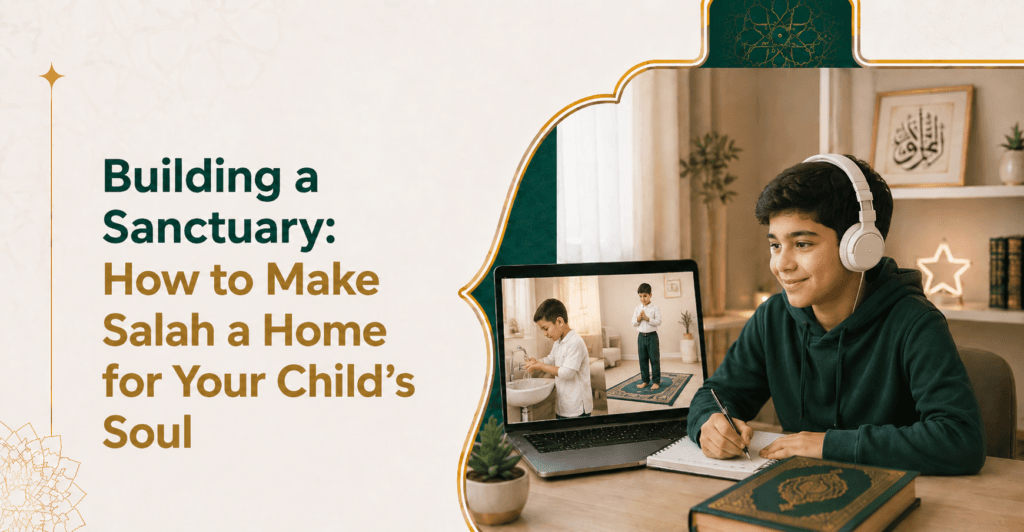
Building a Sanctuary: How to Make Salah a Home for Your Child’s Soul
As Muslim parents raising children in the West, we are hyper-focused on providing them with a secure home. We work long hours to afford safe neighborhoods, research the best schools, and ensure their bedrooms are comfortable spaces where they feel completely protected from the chaotic world outside.
But when it comes to their spiritual life, we often encounter a frustrating, heartbreaking barrier: the daily struggle over Salah.
We find ourselves constantly reminding, micro-managing, or even raising our voices just to get them to the prayer mat. We watch them rush through their movements, reciting words on autopilot, treating prayer like an annoying chore they just want to cross off their to-do list.
The mistake we are making isn’t a lack of effort; it is a structural framing error.
We have accidentally taught our children to view Salah as a rigid “spiritual cage” of rules, obligations, and penalties, rather than what it was designed to be: a beautiful, structural sanctuary where their souls can find rest.
If you want your child to stop running away from prayer and start running toward it, you need to stop viewing Salah as an isolated daily task. You need to understand the architecture of spiritual parenting and learn how to build prayer into a home your children actually want to inhabit.
1. The Central Pillar: Shifting from Compliance to Connection
If you look at the architecture of any durable house, it relies on a central pillar to bear the weight of the entire roof. If that pillar is weak or forced into place incorrectly, the whole structure collapses.
In spiritual parenting, the central pillar is Love and Understanding.
The Compliance Trap: "Pray now or you will be punished." ───► Driven by Fear ───► Resentment
The Connection Method: "Let's plug back into our Source." ───► Driven by Love ───► Refuge
When we only focus on the mechanics of prayer—“Did you do Wudu correctly? Why are your feet moving? Hurry up, the time is ending”—we are building a house out of dry rules.
To a child growing up in a secular, hyper-stimulating environment, these rules feel like a prison. We must shift the narrative. Before teaching them how to bow, we must spend time talking about Who we are bowing to. Connect Salah to gratitude, to a safe space where they can complain to Allah about their hard school days, and to a direct, private conversation with the Creator of the universe.
2. The Architectural Design: Making Prayer a Visual and Sensory Reality
Children—especially those raised in a highly visual, digital Western world—are deeply affected by their physical environment. If prayer is always performed hurriedly in a dark hallway or a messy living room corner while the TV is buzzing, it will never feel sacred.
You need to design a physical “Prayer Sanctuary” inside your home.
- The Power of Environment: Dedicate a specific, clean corner of your house exclusively for Salah. Light it beautifully, perhaps with warm fairy lights or a nice diffuser with a soothing scent like oud or lavender.
- Sensory Ownership: Let your children choose their own high-quality, padded prayer mats and their own prayer clothes.
- The Psychological Triggers: When that specific corner is lit and the scent fills the room, it sends an immediate, subconscious signal to your child’s nervous system: It is time to slow down. It is time to enter my safe space.
3. The Framing: The Three-Step Ritual for Busy Western Schedules
Our children’s schedules are packed with school runs, sports practices, and homework. If we don’t integrate Salah into their routine naturally, it will always feel like an interruption.
To build a sustainable routine, use this simple architectural framing:
Step 1: The Transition Zone (Wudu as a Reset)
Teach your children that Wudu is not just a cleaning ritual; it is a psychological transition. It is the boundary line where they wash away the stress, the screen time, and the academic pressure of the day, preparing their minds to step into a different realm.
Step 2: The Co-Building Phase (Family Congregational Prayer)
A child will rarely value what they see their parents doing in isolation. Lead by example. Make at least one or two prayers a day—like Maghrib or Isha—a non-negotiable family congregation ($Jama’ah$). Let your son give the Athan or let your children take turns setting up the prayer space. When they actively participate in building the prayer, they feel a deep sense of belonging.
Step 3: The Safe Space (The Post-Salah Du’a)
Never let your kids jump up and sprint away the second they say Tasleem. Teach them to sit for just two minutes. This is the moment where the “home” is fully realized. Encourage them to make Du’a in English, using their own words. Say to them: “Tell Allah about your exam tomorrow. Ask Him to help you with that friend at school.” This transforms prayer from a rigid ritual into a living, breathing relationship.
4. Keeping the Roof Up When Life Gets Stormy
Some days, your child will be exhausted, overwhelmed with exams, or simply having a bad day. During these times, a rigid perfectionist approach will break their spirit.
When structural pressure increases, rely on the flexibility of the Shariah.
Teach them that Islam leaves room for human weakness. If they are completely exhausted after a long school day, show them how to pray just the obligatory (Fard) units calmly, rather than forcing them into a long, agonizing routine that ends in tears. Show them that Allah appreciates their effort, no matter how small. Protecting the habit and the love for the prayer mat is always your highest priority.
Co-Building Your Child’s Future at the Hub
At Esraa Quran & Arabic Hub, we don’t just teach the mechanics of recitation and rules; we help you engineer a deep, lifelong love for Islam in your child’s heart. We understand the unique psychological and social pressures your children face in Western schools and universities.
Through our interactive, 1-on-1 programs, our certified instructors act as compassionate mentors. We teach children the true meanings behind what they recite in Salah, transforming their prayers from empty movements into a vibrant, spiritual sanctuary they carry with them wherever they go.
Let’s stop fighting over the prayer mat. Let’s start building a sanctuary together.
- 👉 [Book a Free Trial Lesson for Your Child Today] — Let us help your child discover the peace, rhythm, and beauty hidden within their daily prayers.
- 👉 [Assess Your Child’s Quran & Prayer Readiness] — Take our quick, friendly diagnostic session to build a custom spiritual path for your family.
We’d Love to Hear From You!
Leave a comment below to tell us: Which element of building this spiritual home do you find hardest to practice with your children? Is it finding the consistency in a busy Western schedule, or shifting their mindset away from seeing prayer as an academic chore? Share your thoughts, and let’s help each other step-by-step.