
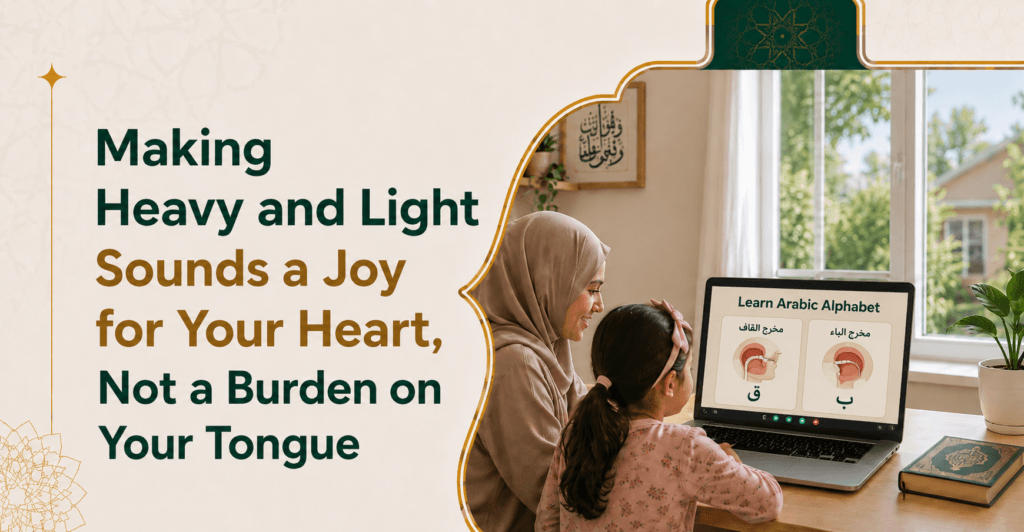
Making Heavy and Light Sounds a Joy for Your Heart, Not a Burden on Your Tongue
Have you ever opened the Quran in your home abroad, reached a word like {خَلَقَ} or {صَلَصَالٍ}, and suddenly stopped? You try to balance the heavy, full sounds (like Khā and Sād) with the light, gentle sounds (like Lām and Mīm), but your tongue feels heavy, and the letters crash into each other. In that very second, a familiar cloud of frustration takes over, and a whisper tells you: “Maybe Arabic is just too hard for me… maybe I started too late.”
If you have ever felt this way, please throw that frustration away right now.
The fine phonetic rules of Arabic—especially the beautiful concept of Tafkheem (heavy sounds) and Tarqeeq (light sounds)—are not an impossible test to prove how “Arab” you are or whether you deserve to read the Quran. It is just a musical, flexible system that takes time and practice. And here is the biggest secret: Even many native Arabic speakers who were born and raised in Arab countries struggle to balance these heavy and light sounds without proper training!
1. Cracking the Code: What Are Heavy and Light Sounds?
In the science of Tajweed, making a letter heavy or light isn’t just about changing your voice; it is about engineering the airflow and the echo inside your mouth:
- Tafkheem (The Powerful, Heavy Sounds): This means making the letter “fat” so that it fills your mouth with an echo. These are letters like the Sād in {صِرَاط} or the Tā in {طَهَ}. When you pronounce them, the back of your tongue rises to create a “resonance chamber.”
- Tarqeeq (The Soft, Light Sounds): This means making the letter thin and gentle, so it doesn’t create an echo. This applies to most Arabic letters, like Bā, Tā, and Sīn.
The real challenge isn’t pronouncing a heavy letter or a light letter on its own. The real challenge is “coexistence”—when a light letter sits right next to a heavy one (like Kha – la – qa). Your tongue naturally wants to make the whole word heavy or the whole word light. Separating them beautifully is where the art and practice come in.
2. You Are Not Alone: The Truth About Native Speakers
Many Western Muslims feel discouraged because they assume every Arab is born naturally mastering Tajweed and the perfect balance of heavy and light letters. This is completely untrue.
The reality in classrooms shows us that:
- The Effect of Dialects: Most native Arabs speak local everyday dialects (Egyptian, Syrian, Gulf, Moroccan) where formal letter rules are relaxed. Some naturally soften heavy letters, while others make light letters heavy in daily speech.
- A Shared Learning Journey: An Arab scholar and a young child both have to sit with a teacher to learn how to pronounce a proper Tā without it sounding like a regular English ‘T’, or how to make the letter Rā heavy or light depending on its vowels.
So, the struggle is not because of your background or your Western upbringing. It is simply a muscle-memory exercise that every single human being has to go through to give each letter its right.
3. How to Build a Healthy Relationship with Your Tongue (Step-by-Step, No Frustration)
To enjoy your learning journey without feeling anxious during your prayers, use this simple framework:
Listen to the Sound ───► Slow Imitation (Break Down the Word) ───► Consistent Practice ───► Feedback from a Teacher
First: Muscles Take Time (Muscle Memory)
Your vocal cords and tongue have been used to English or Western speech sounds for years. Training the back of your tongue to rise for heavy Arabic letters is like going to the gym—you won’t lift the heaviest weights on day one! Give your muscles time to adjust.
Second: Break the Word Down
When you face a difficult word like {مَخْمَصَةٍ}, don’t try to say it all at once. Break it into pieces: (Ma – Kh – ma – Sa – tin). Say the light Ma, then switch to the heavy Kh, go back to the light ma, and then hit the heavy Sa. This slow breakdown teaches your brain how to steer your tongue consciously.
Third: Worship Through the Struggle
Remember the beautiful reward promised by the Prophet Muhammad (ﷺ): “The one who recites the Quran and stammers over it, finding it difficult, will have a double reward.” (Agreed upon). The stuttering, the mistakes, and trying again are not signs of failure; they are the exact reasons your rewards are being multiplied by Allah.
How We Support You at the Hub
At Esraa Quran & Arabic Hub, we don’t look at your mistakes in heavy and light sounds as a problem to judge you for. We look at them as an exciting starting point.
Our certified, patient instructors understand the exact phonetic differences between English and Arabic. We provide a safe, completely judgment-free, 1-on-1 learning environment. We focus on training your tongue step-by-step using fun visual and vocal exercises that fit into your busy Western schedule, turning heavy rules into a smooth, beautiful rhythm you can feel in your prayers.
We’d Love to Hear From You!
Leave a comment below to tell us: Which part of this journey do you find hardest in your daily routine? Is it separating light letters from heavy ones when they are right next to each other, or finding consistent time for tongue exercises? Share your challenges, and we will be happy to help you step-by-step.
Esraa Quran & Arabic Hub
Connecting Hearts to the Divine Revelation, Wherever You Are.
📩 Contact us at: info@esraaquranarabichub.com