
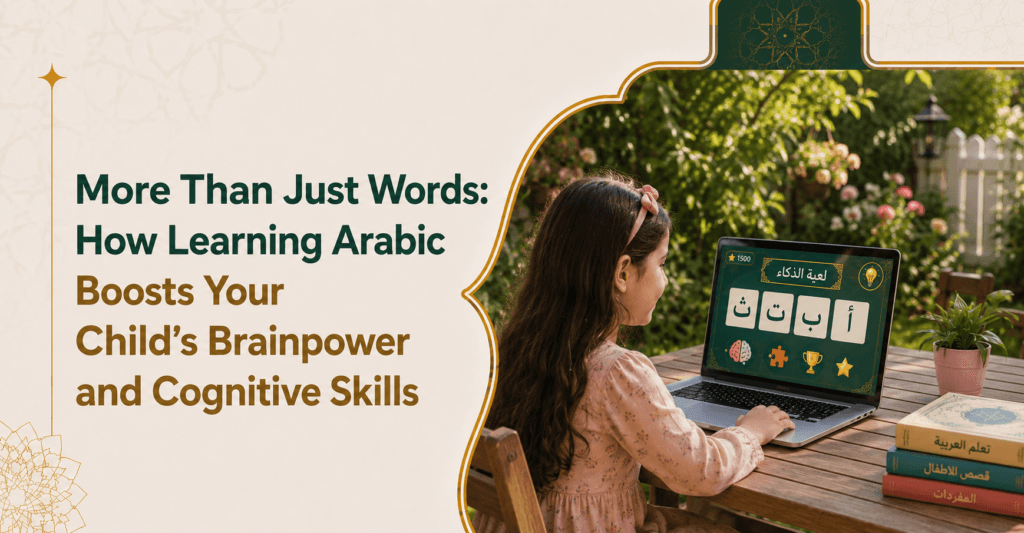
More Than Just Words: How Learning Arabic Boosts Your Child’s Brainpower and Cognitive Skills
When parents living abroad think about teaching their children Arabic, the primary motivations are usually religious or the desire to connect the child with their family roots and mother culture. These are undoubtedly noble and foundational goals, but modern science reveals another astonishing dimension that might completely change how you view your child’s Arabic class.
The latest research in cognitive neuroscience proves that learning Arabic is not just about adding new words to your child’s vocabulary; it is an active “re-engineering process” that comprehensively boosts their brainpower and cognitive skills. Choosing to teach your child Arabic while living in the West is, in fact, one of the best academic and mental investments you can give them. Let us discover together how Arabic transforms your child’s brain into a super-smart mental gym.
1. The Root System: The Ultimate Training for Problem-Solving Skills
Most languages our children learn in Western schools (like English or French) rely heavily on raw word memorization and vocabulary accumulation. Arabic, however, is entirely different; it is an inflectional, mathematical language built upon a unique “three-letter root system.”
In the human brain, this system acts like a high-speed data processor. When a child learns that the root K-T-B (ك-ت-ب) generates: Kitab (book), Maktabah (library), Katib (writer), Maktoub (written), and Yaktub (he writes), their brain is not just memorizing five separate words. Instead, it is performing a mathematical analysis and logical connection to decode patterns.
                  ┌───► Kitab (Book - Object)
                  ├───► Maktabah (Library - Place)
[ Root: K - T - B ] ├───► Katib (Writer - Subject)
                  └───► Yaktub (Writes - Action)
* Result: Continuous stimulation of the brain's analytical thinking and problem-solving networks.
Neuro-linguistic studies show that dealing with a highly structural root-based language significantly enhances cognitive flexibility and boosts a child’s capacity to solve complex mathematical and logical puzzles. Their brains become naturally trained to trace branches back to their origins and dissect patterns effortlessly.
2. From Right to Left: Visual Architecture That Activates Unique Brain Regions
Arabic possesses distinct visual and phonetic features that make it entirely unique in brain anatomy:
- The Reverse Direction and Visual Mapping: Reading and writing from right to left, while tracking cursive letters that change shape based on their position in a word, forces the brain to coordinate both the right and left hemispheres symmetrically. The child needs high visual focus to distinguish subtle differences between letters (such as ج, ح, خ), which rapidly develops their visuospatial processing skills.
- Precise Phonetic Engineering: Arabic contains articulation points and close-sounding letters that do not exist in Western languages (such as ق/ك, ص/س, ط/ت, ع, ح). Distinguishing these sounds auditorily and pronouncing them correctly intensely stimulates the auditory cortex and speech control areas in the brain. This phonetic exercise refines the child’s auditory sensitivity, making it much easier for them to pick up other foreign languages and native accents in the future.
Arabic as a Fun Mental Gym and Academic Advantage
Instead of treating Arabic lessons as an extra household chore, we want parents and students to see them as a “mental gym”—just like solving puzzles or playing chess, but a sport that builds both the soul and the mind. A bilingual child who masters Arabic alongside English enjoys a stronger “cognitive reserve,” better focus retention, and a noticeable academic advantage in science and mathematics due to continuous neuro-stimulation.
At Esraa Quran & Arabic Hub, we design our smart digital curriculum to fully capitalize on these cognitive benefits. We do not rely on dry memorization. Instead, we use gamification and interactive educational infographics that stimulate your child’s visual and logical intelligence. We guide your child to navigate the beautiful architecture of the Arabic language with agility, boosting their brainpower, expanding their horizons, and helping them grow proud of their identity and exceptional in their Western school and community.
Share Your Success Stories With Us!
Leave a comment below to tell us: Have you noticed an improvement in your children’s observation skills, focus, or logical analysis since they began their journey of learning Arabic and reading the Quran?
We always love reading your stories and sharing insights that inspire us to deliver the best for our children’s promising minds.
Esraa Quran & Arabic Hub
Connecting Hearts to the Divine Revelation, Wherever You Are.
📩 Contact us at: info@esraaquranarabichub.com