
Why “Alhamdulillah” is Your Child’s Ultimate Online Learning Weapon
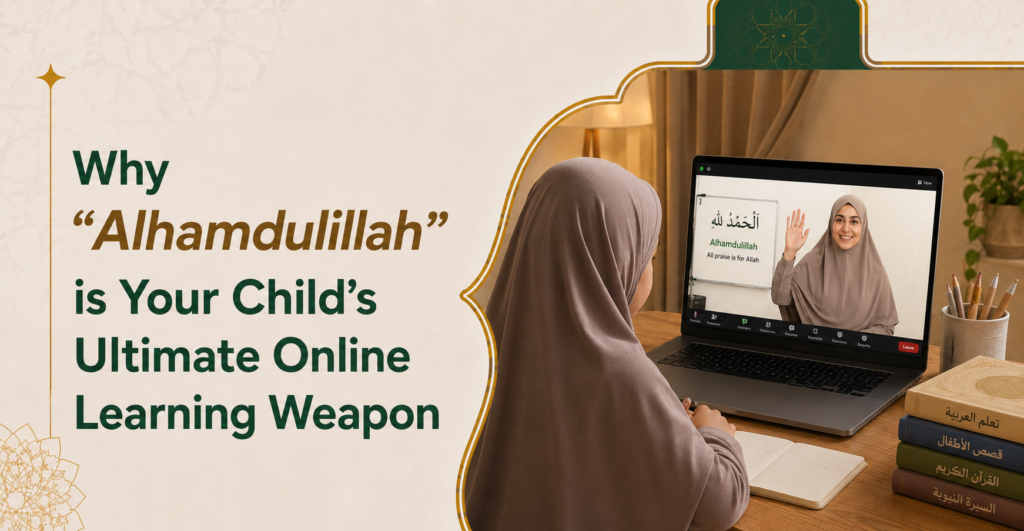
In our fast-paced Western environments, our children hear and repeat one phrase almost every single day: “Alhamdulillah.” We say it after finishing a meal. We use it when someone asks how we are doing. It serves as our standard social greeting.
However, in modern digital education, this single phrase transforms. It changes from a mere cultural habit into a powerful cognitive tool. In remote learning, it becomes the thin line between a distracted student and an academically outstanding child.
Standard Western translations routinely flatten this phrase into generic terms like “Praise be to God” or “Thank God.” Yet, a closer look at its linguistic engineering reveals an entire growth-mindset system. When a student activates this system during online studies, it completely revolutionizes how they process focus, setbacks, and academic achievement.
1. The Linguistic Anatomy: Shukr vs. Hamd
The Arabic language draws a sharp, definitive line between concepts. Through precise morphological roots, we learn that Shukr and Hamd are not identical.
- Shukr (الشُّكْر): This is a reactive response to a direct, timely benefit. You thank someone for a specific favor. It is conditional and temporary.
- Hamd (الحَمْد): This is the ultimate praise based on intrinsic perfection. You praise the giver regardless of whether you received a direct benefit in that exact second. It is sustainable and absolute.
- The Prefix “Li-” (لِلَّهِ): In Arabic grammar, this signifies exclusive ownership. True, unblemished praise belongs uniquely to Allah.
The Positivity Engine:
Shukr= Reactive $\rightarrow$ Conditional & Temporary.Hamd= Active $\rightarrow$ Absolute & Sustainable.
When our children start their day by mindfully saying Alhamdulillah, their subconscious mind receives a grounding signal. They realize that the universe is governed by flawless order. This builds a psychological anchor, giving them the emotional stability needed to face complex academic tasks calmly.
2. The Prophetic Growth Mindset “Under All Conditions”
Islamic psychology teaches us that Hamd is not a luxury phrase reserved only for moments of celebration. Instead, it is a fortress we run to when motivation dips.
The Prophet Muhammad (PBUH) beautifully modeled this balanced mindset. When something pleasing reached him, he said: “Alhamdulillah by whose blessing good things are perfected.” If something distressing occurred, he said: “Alhamdulillah under all conditions.” (Sahih al-Jami’).
Modern psychologists call this a “Growth Mindset.” “`
[Fixed Mindset] ──► Struggles with a rule ──► Gets frustrated ──► Closes laptop
[Growth Mindset] ──► Struggles with a rule ──► Says Alhamdulillah ──► Tries again with patience
A student who embodies Alhamdulillah views difficulties as natural checkpoints. They praise Allah for today’s effort, recognizing that temporary struggle reshapes their intellect.
3. Deconstructing Online Learning Challenges
Studying behind screens in the UK, USA, Canada, or Australia presents unique cognitive hurdles. Alhamdulillah serves as a direct antidote to these modern educational challenges:
🎯 Eliminating Digital Distractions
When a student opens their session with a conscious Alhamdulillah, it acts as a mental “Reset” button. It breaks the cycle of wandering thoughts, anchoring their attention span firmly into the sacred space of learning.
📈 Activating the Law of Academic Increase
Allah states in the Quran: “If you are grateful, I will surely increase you.” (Surah Ibrahim 14:7). Since Hamd is the highest form of gratitude, maintaining it unlocks deeper comprehension. A mindful student often retains in one online hour what takes a distracted mind days to process.
🌐 Breaking Virtual Isolation
Online learning can occasionally feel isolating for a child sitting alone in their room. Connecting with Alhamdulillah instantly tethers them to the source of all strength. They feel divine companionship, transforming a flat screen into an active, sacred partnership.
Engineering Mindful Success at Esraa Quran & Arabic Hub
At Esraa Quran & Arabic Hub, we refuse to treat daily remembrance (Adhkar) as dry, mechanical chants. We teach them as an intentional, intelligent lifestyle choice.
In our personalized, 1-on-1 private sessions, we do more than teach letters on a screen. We guide children to decode the profound meanings behind what they speak. When a student masters a difficult linguistic root, we teach them how to bow their hearts in Hamd. This builds an unshakeable, confident Muslim identity that allows them to thrive both academically and culturally within Western societies.
👉 [Book a 100% Free Trial Private Session for Your Child Now] — Let your child discover the sheer joy of visual, mindful, and expert-led online education.
👉 [Explore Our Website’s Library & Interactive Juz’ ‘Amma Dashboard] — Step into our premium digital workspace to discover how we convert classical text and linguistic roots into interactive mind maps.
The 5-Minute Cognitive Challenge
The next time your child powers up their laptop for class, ask them to pause for 30 seconds. Have them take a deep breath and say “Alhamdulillah” slowly.
Encourage them to actively visualize their blessings: the miracle of the internet, a healthy intellect, and an expert teacher ready to simplify the language of revelation. Watch closely how this tiny, mindful shift completely flips the energy of the session from a heavy chore into an inspired journey of light.
Drop a comment below and share your parenting insights: How has teaching your children to practice conscious gratitude (Hamd) helped them navigate screen fatigue during their online studies?
Esraa Quran & Arabic Hub Connecting Hearts to the Divine Revelation, Wherever You Are. 📩