
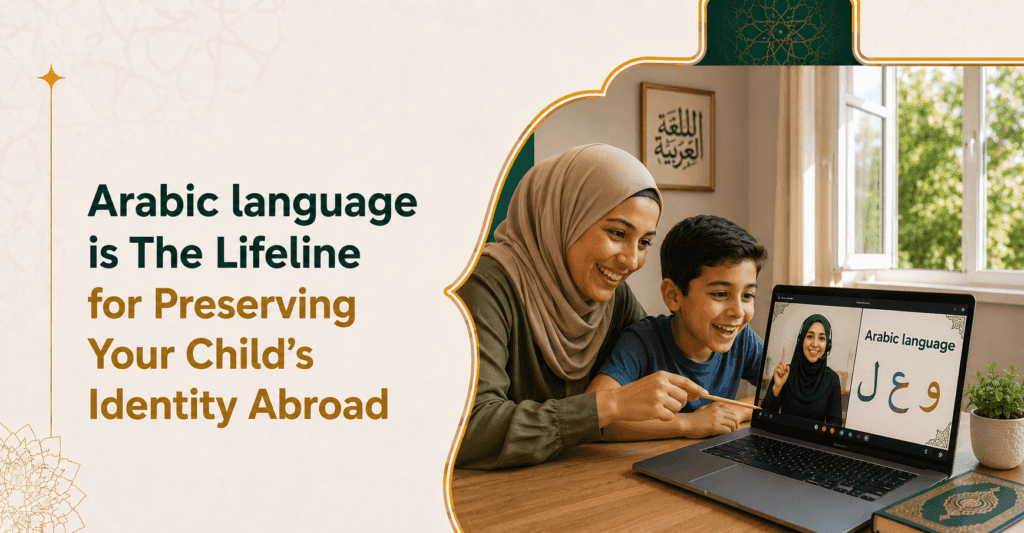
Every Muslim parent raising children in a Western society shares a quiet, recurring anxiety. It’s an underlying fear that surfaces during everyday moments—like watching your children talk to their peers, scroll through social media, or navigate a secular school environment.
The question that haunts us is always the same: In ten or fifteen years, will my children still know who they are? Will they hold onto their roots, or will they completely blend into the background of a culture that doesn’t reflect their values?
Living abroad offers incredible academic and career opportunities. But it also creates a silent, gradual drift.
Many parents try to fix this by enforcing rigid rules at home, only to face pushback. The missing link isn’t a lack of discipline; it is a loss of the language.
In exile or diaspora, the Arabic language is never just an academic subject or a secondary skill to put on a resume. It is the ultimate lifeline holding your child’s spiritual and cultural identity together. When the language disappears, the anchor drops, and the child is left to drift.
1. Protecting the Core: Building an Unbreakable Shield for Their Faith
It is entirely possible for your child to learn the basics of Islam through English books and translated podcasts. They can learn what to do, but translations often fail to capture the emotional weight, the rhythm, and the soul-stirring conviction of the divine revelation.
Learning Islam via Translation: ───► Informational ───► Brain Level (Logic Only)
Learning Islam via Arabic:      ───► Experiential  ───► Heart Level (Conviction)
When your child understands Arabic, they don’t just memorize the Quran; they feel it.
During Salah, the verses protect them in real-time. It creates an internal, spiritual shield that guards their heart against peer pressure, identity crises, and the moral confusion of modern society. They stop practicing Islam simply because “mom and dad said so,” and start practicing it out of deep, personal conviction.
2. Healing the Silent Heartbreak: Bridging the Generational Gap
There is a unique, quiet heartbreak that happens in many Muslim households abroad. It’s the awkward silence when a child is handed the phone to speak with their grandparents, aunts, or cousins back home, only to respond in hesitant, broken syllables, or worse—to look at their parents to translate.
- Losing the Family Narrative: When children lose their native tongue, they lose access to their family’s history, stories, and wisdom.
- The Bridge of Love: Retaining Arabic ensures that your child always feels a deep sense of belonging and warmth within their own lineage. It transforms family visits back home from an alienating experience into a joyful homecoming where they feel proud of where they come from.
3. The Psychology of Roots: Cultivating Confident, Resilient Leaders
Many parents worry that focusing heavily on Arabic will slow down their child’s integration or success in Western schools. Psychological and educational studies prove the exact opposite.
Children who are deeply secure in their native linguistic and cultural identity are statistically far more confident, resilient, and successful in Western academic and professional environments.
When a child knows exactly who they are, they don’t spend their energy trying to desperately mimic others to fit in. Arabic gives your child the psychological grounding to stand tall as a leader, a critical thinker, and a cultural ambassador, rather than someone who constantly blends into the background.
Why Modern Parents Choose Esraa Quran & Arabic Hub
We understand the reality of raising kids in the West. Your child’s schedule is already packed with school runs, homework, and extracurricular activities. Forcing them into traditional, rigid, or intimidating weekend classrooms will only create resentment toward the language of their faith.
That is why we do things completely differently.
At Esraa Quran & Arabic Hub, we combine deep cultural empathy with modern, engaging methodologies. We use gamified learning tools, interactive 3D elements, and compassionate, certified teachers who truly understand the psychology of children growing up in a Western context. We don’t just teach dry vocabulary lists; we protect your child’s identity and make them genuinely look forward to every session.
Don’t let the linguistic and emotional gap widen any further. Secure their roots today so they can flourish tomorrow.
- 👉 [Book Your Child’s Free Trial Session Today] — Take the first step in anchoring your child’s identity in a safe, personalized, 1-on-1 environment.
- 👉 [Check Your Child’s Arabic Fluency Level] — Let our specialized instructors gently assess your child’s current level and design a custom path forward.
Frequently Asked Questions (FAQ)
Q1: My child completely refuses to speak Arabic at home. Is it too late to start?
It is never too late. Resistance usually happens because children associate Arabic with pressure, scolding, or boring memorization. When we shift the environment to an interactive, game-based, 1-on-1 setup where they experience a sense of accomplishment without judgment, that resistance quickly turns into curiosity and enthusiasm.
Q2: Can an hour or two a week online really save my child’s identity?
Consistency beats intensity every single time. One or two hours of high-focus, personalized 1-on-1 instruction per week—where the child is actively speaking, playing, and engaging rather than just listening to a lecture—creates a massive cognitive shift. It rewires their relationship with the language and activates their desire to use it outside the classroom.
Q3: We speak English exclusively at home. Will this course still work for my kids?
Yes, explicitly. Our curriculum is specifically engineered for English-centric environments. Our teachers use bilingual strategies to ease your child into the language comfortably, ensuring they understand the concepts perfectly without feeling overwhelmed or lost.
We’d Love to Hear From You!
As a parent navigating the challenges of raising children abroad, which part of this article hit closest to home? Do you feel your biggest daily struggle is protecting their faith in a highly secularized world, or is it maintaining that sweet, emotional bond with your extended family back home?
Let us know your experiences and thoughts in the comments below!