
The Language of Paradise: Connecting Your Child’s Heart to the Heritage of Eternity
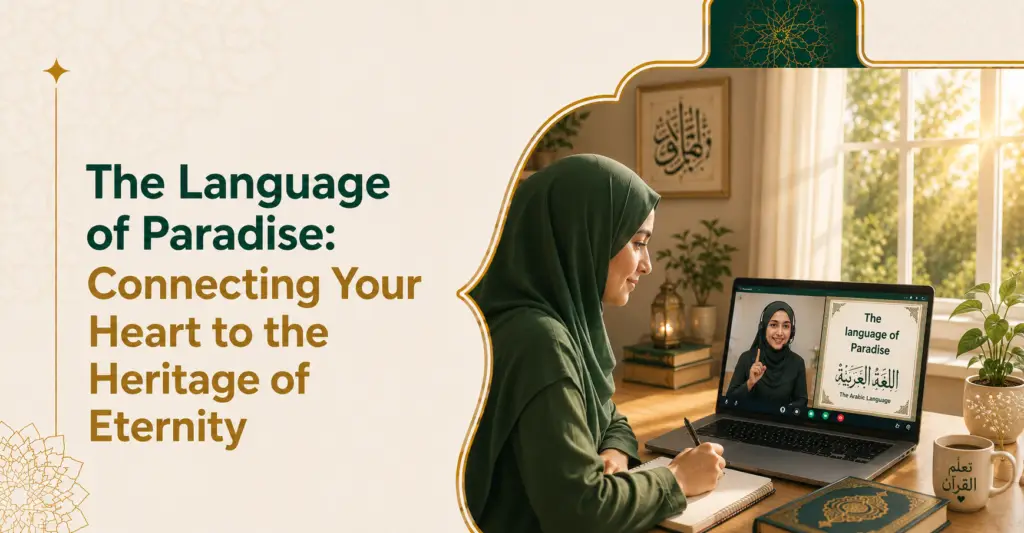
For Muslim parents raising children in the West, there is a common, bittersweet cycle we all experience. We invest heavily in our children’s secular education—ensuring they excel in math, science, and extracurriculars to secure their future in this worldly life ($Dunya$).
Yet, when it comes to the Arabic language, we often hit a wall of resistance.
We look at our children struggling with textbook grammar or dragging their feet to traditional classes, and we absorb a discouraging thought: Maybe it’s just too hard for them. Maybe knowing a few short Surahs is enough.
The mistake we are making isn’t a lack of effort; it is a faulty framing of the language.
We have accidentally taught our children to view Arabic as a “difficult academic subject” to be tested on, rather than what it truly is: a beautiful spiritual journey that connects them directly to their ultimate home.
Arabic isn’t just a tool for worldly communication or career advancement. For a believer, it is the language associated with eternity. It is the language of Paradise ($Ahl\ al-Jannah$). When you shift your perspective—and your child’s perspective—from academic obligation to eternal heritage, the entire learning experience transforms.
The Ultimate Honor: Decoding the Exact Words of the Creator
Before looking at the life of the Hereafter, we have to look at why Arabic holds such an elevated status in the first place. Allah (SWT) did not choose Arabic arbitrarily; He chose it as the ultimate, precise vessel for His final and most perfect message to humanity.
“Indeed, We have sent it down as an Arabic Qur’an that you might understand.” (Surah Yusuf, 12:2)
When your child learns Quranic Arabic, they are doing something far deeper than memorizing foreign vocabulary. They are decoding the exact words spoken by Allah (SWT), transmitted through the Angel Jibreel to Prophet Muhammad (ﷺ).
Classical Arabic carries an unparalleled depth where just a few syllables can capture immense spiritual meaning. By teaching them this language, you are unlocking the ability for them to hear Allah’s message directly, exactly as it was revealed, without the dilution or barrier of human translation.
A Glimpse into Jannah: Practicing the Speech of Our True Home
Imagine a realm of ultimate peace. A place with no sorrow, no exhaustion, no cultural divides, and no misunderstandings. The scholarly consensus points to a beautiful reality: the language spoken in this realm of eternity—the language of the people of Paradise—will be Arabic.
Think about the moment the believers enter through the gates of Jannah. The very greetings exchanged between them and the angels will echo in this beautiful tongue:
“Their greeting therein will be, ‘Peace’ (Salam).” (Surah Yunus, 10:10)
The Perspective Shift:
Traditional View: “Learn Arabic so you don’t forget your cultural roots.”
Eternal View: “Learn Arabic to practice the speech of your eternal home.”
By introducing your children to Arabic today, you are not just teaching a second language to put on a resume. You are preparing their tongues, minds, and hearts for the beautiful speech of eternity. You are giving them a sweet, earthly taste of Jannah right inside your living room.
Turning Rituals into Relationships: How Eternity Transforms Daily Worship
When a young learner understands that Arabic is the key to the ultimate home, their daily relationship with worship undergoes a profound shift. It stops feeling like a chore or a checklist and starts feeling like an exclusive privilege.
This understanding completely redefines three core pillars of their daily life:
- Real Khushu’ (Focus) in Salah: Prayer is no longer a mechanical recitation of memorized sounds. It becomes a conscious, real-time conversation with the Lord of the Worlds in the exact language He chose.
- A Living Bond with the Qur’an: Reading the Book of Allah becomes an active emotional experience. The meanings penetrate their hearts directly, creating an anchor of identity that protects them from the distractions of a secular environment.
- Walking with the Prophet (ﷺ): It brings them closer to the Sunnah, helping them feel the precise emotional nuances and depth behind the daily Prophetic supplications ($Adhkar$).
Overcoming the Environment Barrier: Turning Struggle into Devotion
Let’s be honest: learning Classical Arabic while living in a non-Arabic speaking country is challenging. It requires patience, consistency, and a highly encouraging environment.
But as parents, we can help our children channel this challenge into a beautiful form of worship.
When we remind them that every letter they practice, every root word they master, and every linguistic obstacle they overcome is bringing them one step closer to perfecting the speech of Paradise, the hardship evaporates. It turns into a rewarding devotion. They realize that their digital classroom efforts aren’t just tracking toward a report card—they are tracking toward an eternal reward.
Start Your Family’s Journey to Eternity
At Esraa Quran & Arabic Hub, we specialize in bridging the gap between structured, high-quality language learning and deep spiritual growth. We do not believe in dry, boring, or intimidating memorization. Instead, we focus on making Arabic engaging, highly accessible, and profoundly rooted in Islamic values for children and adults alike.
We design our lessons to fit perfectly around busy Western schedules, providing a nurturing, 1-on-1 space where your child can fall in love with the language of the Qur’an at their own pace.
Give your children the gift of their eternal heritage.
- 👉 [Book Your Free Trial Session Today] — Let us guide your children toward falling in love with the language of Paradise.
- 👉 [Test Your Child’s Arabic Level] — Take our quick, friendly assessment to see where their spiritual and linguistic journey begins.
Frequently Asked Questions (FAQ)
Q1: My child finds Arabic classes boring and difficult. How is your approach different?
Children find Arabic difficult when it is taught through dry, repetitive memorization disconnected from meaning. At our Hub, we bring the language to life by linking vocabulary to the stories of the Quran and the beauty of Jannah. We use interactive, 1-on-1 methods that keep young learners engaged, turning lessons into a highlight of their week rather than a burden.
Q2: Is it possible for a child with zero Arabic background to learn Classical Arabic online?
Yes, absolutely. In fact, starting with a clean slate allows us to build the correct pronunciation and foundational vocabulary without any bad habits. Our certified teachers are experts in guiding absolute beginners step-by-step, ensuring they feel confident from their very first session.
Q3: Why should I choose 1-on-1 lessons for my child instead of a weekend group school?
In a group class of 15 or 20 students, a child rarely gets more than a few minutes of direct speaking time, and individual mistakes often go unnoticed. 1-on-1 sessions give your child 100% of the teacher’s attention. This personalized pacing allows them to retain information faster, correct mistakes instantly, and build a genuine bond with their instructor.