
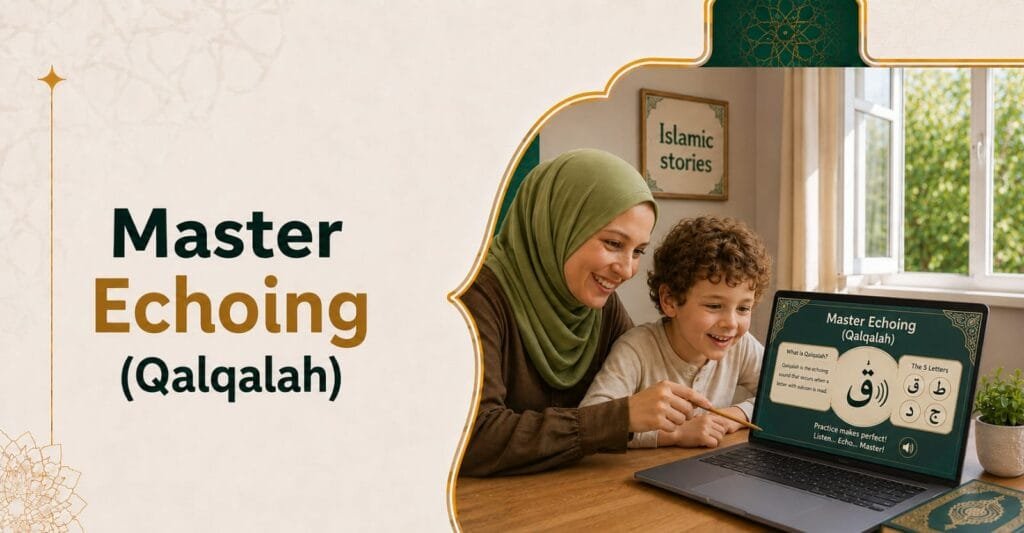
Master Qalqalah in Quran: Easy Guide to the Echoing Sounds in Tajweed
Learning Quranic Tajweed often feels like a daunting task, especially for non-native Arabic speakers. The technical terminology and intricate rules can seem overwhelming at first. However, Tajweed is far more accessible than it appears! Many of its foundational concepts already exist in natural, everyday speech—including English.
One of the most rhythmic and distinctive rules in Quran recitation is Qalqalah (القَلْقَلَة). If you have ever spoken English with emphasis or clarity, you already possess the exact vocal mechanics required to master it.
What is Qalqalah?
In Arabic, the word Qalqalah literally means “shaking,” “disturbance,” or “echoing.”
In Tajweed, Qalqalah refers to a quick, bouncing or echoing release of sound that happens when one of five specific Arabic letters carries a Sukun (سُكُون – static state with no vowel) or when you stop at the end of a verse on one of these letters.
Without Qalqalah, these letters would sound muffled, suppressed, or difficult to hear clearly. The subtle bounce gives the letter its proper resonance and clarity without adding an extra vowel sound (like a Fatha, Kasra, or Damma).
The 5 Qalqalah Letters
To make them easy to memorize, Muslim scholars grouped the five Qalqalah letters into a simple mnemonic phrase:{قُطْبُ جَدٍّ} {Qutb Jaddin}
The five letters are:
- ق (Qaf)
- ط (Taa)
- ب (Baa)
- ج (Jeem)
- د (Dal)
Whenever any of these five letters appears with a Sukun (ْ) or at a pause point, Qalqalah must be applied.
The English Connection: You Already Do This!
It is easy to assume that Tajweed rules are completely foreign, but the mechanics of Qalqalah exist naturally in English phonetics when we emphasize final consonant sounds.
Think about how you clearly pronounce ending consonants in English words when speaking articulately:
- The letter “P” or “B”: Say the word “Cup” or “Tap”. When you release your lips at the end of the word, there is a tiny, natural puff of air and bounce: “cup-uh”.
- The letter “T” or “D”: Say the word “Bad” or “Raound”. As your tongue leaves the roof of your mouth, a subtle release of sound occurs automatically.
That quick, effortless release of pressure at the end of the consonant is the exact physical motion used in Qalqalah! You are not creating a full new vowel; you are simply allowing the trapped air to escape naturally with a quick bounce.
The Levels of Qalqalah
To recite accurately, it helps to understand that Qalqalah varies in strength depending on where the letter appears:
1. Qalqalah Sughra (Minor / Small Echo)
This occurs when a Qalqalah letter carries a Sukun in the middle of a word or phrase, and you continue reading without stopping. It is a light, subtle bounce.
- Example: In Surah Al-Kawthar: {إِنَّ شَانِئَكَ هُوَ الْأَبْتَرُ} (Inna shani’aka huwal-Abtar) — Notice the light bounce on the ب in Al-Abtar.
2. Qalqalah Kubra (Major / Strong Echo)
This occurs when a Qalqalah letter is at the end of a word and you stop on it (making it temporarily Sakin). The echoing sound is clearer and more pronounced.
- Example: In Surah Al-Ikhlas: {قُلْ هُوَ اللَّهُ أَحَدٌ} (Qul huwal-lahu ahad) — When stopping on Ahad, the final د receives a strong, clear bounce.
3. Qalqalah Akbar (The Strongest Echo – Optional Category)
Some scholars highlight a third level when a Qalqalah letter at the end of a word has a Shaddah (ّ) and you stop on it. The sound is held briefly before the release.
- Example: In Surah Al-Masad: {تَبَّتْ يَدَا أَبِي لَهَبٍ وَتَبَّ}(Tabbat yadaa abii Lahabiw-wa tabb) — The bounce on ب in Watabb is firm and pronounced.
Common Mistakes to Avoid
- Adding a Vowel (Harakah): Do not bounce so hard that it sounds like a Fatha (e.g., turning “Ahad” into “Ahada”). The bounce should be crisp and vowelless.
- Stretching the Bounce: Keep the release quick and immediate; do not linger on the echo.
- Applying it to Other Letters: Remember that Qalqalah belongs only to the five letters ($\text{ق – ط – ب – ج – د}$).
Tajweed is not designed to be difficult; it is a simple framework to help you recite the Quran naturally, clearly, and beautifully. By recognizing that sounds like Qalqalah already exist in everyday speech, you take another confident step forward in your Quranic journey.
If you are still unsure how to produce the sound correctly, book your free trial session with us today—100% free!
📧Contact us: info@esraaquranarabichub.com
📱WhatsApp: +201070166574