
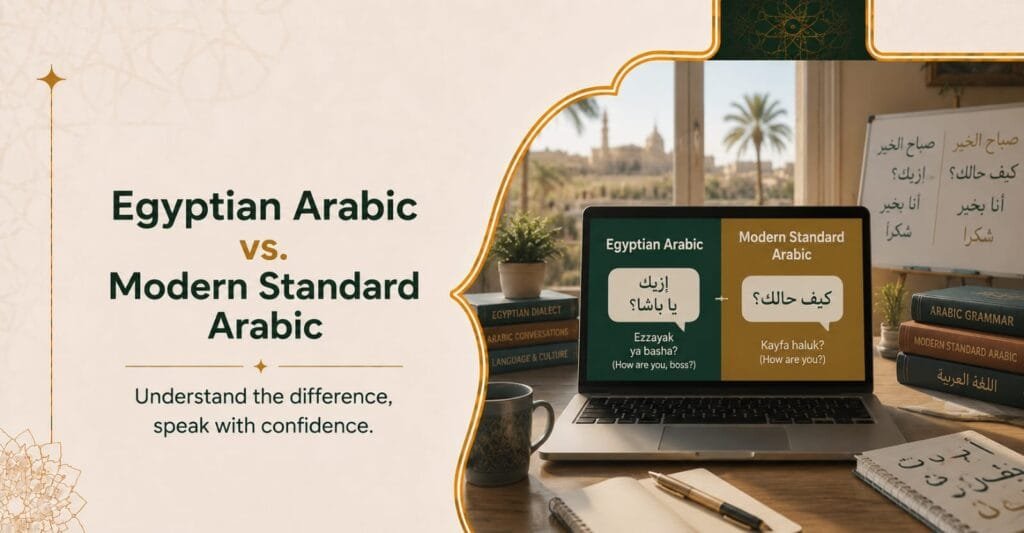
Modern Standard Arabic vs. Egyptian Arabic: What’s the Difference?
If you are starting your Arabic learning journey, one of the first crossroads you will face is deciding between Modern Standard Arabic (MSA) and a spoken dialect—most notably, Egyptian Arabic. Both are powerful tools for communication, but they serve entirely different roles in the Arabic-speaking world. Understanding how they differ will help you set clear learning goals and choose the right path for your needs.
Overview Comparison
| Feature | Modern Standard Arabic (Fusha) | Egyptian Arabic (Ammiya) |
| Primary Role | Formal writing, literature, news, and official documents. | Everyday conversation, street life, music, and cinema. |
| Geographic Reach | Universal across all 22 Arabic-speaking countries. | Native to Egypt, but understood universally across the Arab world. |
| Grammar & Structure | Complex case endings, strict rules, and formal sentence structure. | Simplified grammar, relaxed sentence patterns, and no case endings. |
| Learning Goal | Reading media, academic study, religious texts, and formal writing. | Speaking with locals, watching Egyptian movies, and daily interactions. |
Key Differences Every Learner Should Know
- Pronunciation Shift: Egyptian Arabic frequently modifies certain standard letters. For example, the MSA letter ج (Jeen, pronounced “J”) becomes a hard “G” in Cairo (e.g., Jameel becomes Gameel). The letter ق (Qaf) is often dropped in daily speech and replaced with a soft glottal stop (‘Aa-fa instead of Ta-fa-qa).
- Grammatical Simplification: While MSA requires mastery of complex case endings (I’raab) and dual verb forms, Egyptian Arabic eliminates case endings entirely and relies on word order and context for clarity.
- Cultural Influence: Thanks to Egypt’s historical role as the cultural powerhouse of Arab cinema, music, and television, Egyptian Ammiya is the most widely understood spoken dialect from North Africa to the Gulf.
Which One Should You Learn First?
- Choose Modern Standard Arabic if: Your primary objective is to read literature, access news broadcasts, work in diplomacy or journalism, or study Islamic texts.
- Choose Egyptian Arabic if: Your primary goal is to speak casually with locals, travel comfortably in Egypt, understand Arabic pop culture, or connect socially right away.
Both forms of the language exist in harmony—a phenomenon known as diglossia. Learning how they interact will not only improve your fluency but also deepen your appreciation for Arabic culture.