
What is Tajweed? An Easy Beginner’s Guide to Quran Recitation
When starting your journey to read the Quran, one of the first words you will hear is Tajweed (التجويد). For many non-native speakers, Tajweed sounds like a complex, intimidating science reserved only for scholars and experts. But here is the secret: Tajweed is much easier than it seems!
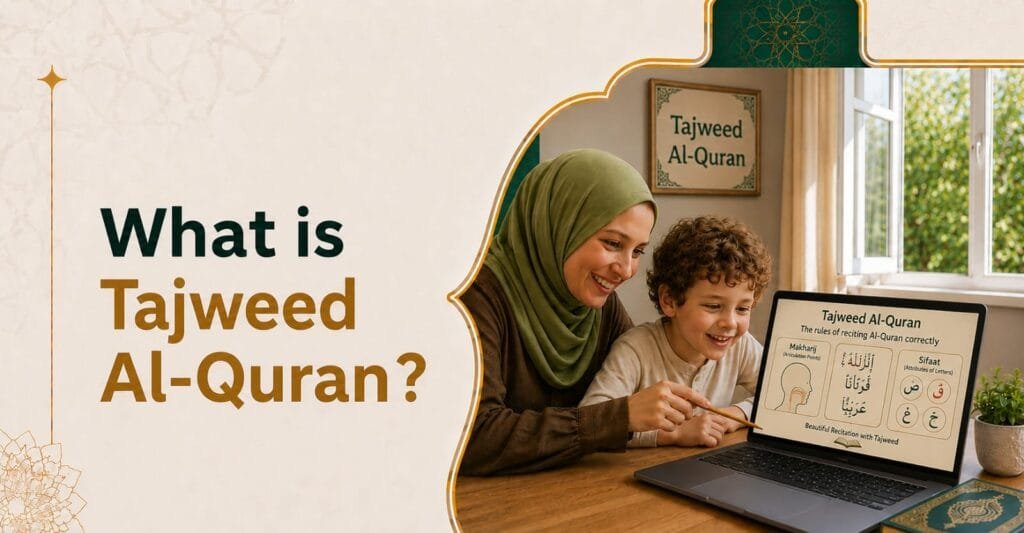
At its core, Tajweed is simply a set of natural rules designed to help you recite the Quran clearly, accurately, and beautifully—the exact way it was revealed to the Prophet Muhammad (peace be upon him).
What Does “Tajweed” Mean?
Linguistically, the Arabic word Tajweed comes from the root Jawwada (جَوَّدَ), which literally means “to improve,” “to make better,” or “to beautify.”
In Quranic studies, Tajweed is defined as:
Giving every letter of the Quran its right (Haqq) and its dues (Mustahaqq) regarding its articulation point, characteristics, and rules.
Think of it like music notation in Western music or proper grammar and pronunciation in English. When you speak English, you naturally follow rules of stress, pauses, and silent letters so that your speech makes sense. Tajweed does the exact same thing for the Quran.
The English Connection: You Already Use Tajweed Principles!
It is easy to assume that Tajweed rules are entirely foreign, but the core ideas behind Tajweed already exist in how you speak English every day:
- Phonetics & Accent: In English, you know that the “th” in think is pronounced differently from the “th” in this. Similarly, Tajweed guides your tongue to distinguish between soft letters (like ت) and heavy letters (like ط).
- Pacing & Rhythm: When reading a book aloud, you naturally pause at commas and stop at periods. Tajweed provides clear stopping signs (Waqf) so you don’t change the meaning of a divine verse mid-sentence.
- Stretching Sounds: In everyday speech, you lengthen vowels when emphasizing a point (e.g., saying “soooo good”). In Tajweed, lengthening rules (Madd) tell you exactly how many counts to stretch a vowel for clarity and beauty.
Why Is Learning Tajweed So Important?
Learning Tajweed is not just about sounding melodious; it serves two essential purposes:
1. Preserving the Correct Meaning
Arabic is a precise language where changing a single sound can alter the entire meaning of a word.
- Example: The word قَلْب (Qalb) with a heavy ق means “Heart.” But if pronounced with a light ك as كَلْب (Kalb), it means “Dog.” Tajweed protects you from making these critical mistakes.
2. Following the Prophetic Sunnah
The Quran was preserved and transmitted orally with Tajweed. Reciting with Tajweed allows you to connect directly with the authentic tradition of Quranic recitation passed down through generations.
Is Tajweed Difficult for Non-Native Speakers?
Not at all! You do not need to master complex Arabic grammar to learn basic Tajweed. By breaking down the rules into manageable building blocks—such as nasal sounds (Ghunnah), echoing sounds (Qalqalah), and heavy/light letters (Tafkheem & Tarqeeq)—anyone can learn to recite properly with regular practice.
Tajweed is not meant to be rigid or stressful; it is a supportive framework designed to help you connect deeply with the Words of Allah.
If you are still unsure how to start or want to perfect your recitation, book your free trial session with us today—100% free!
Contact us: info@esraaquranarabichubgmail.com
WhatsApp: +201070166574