
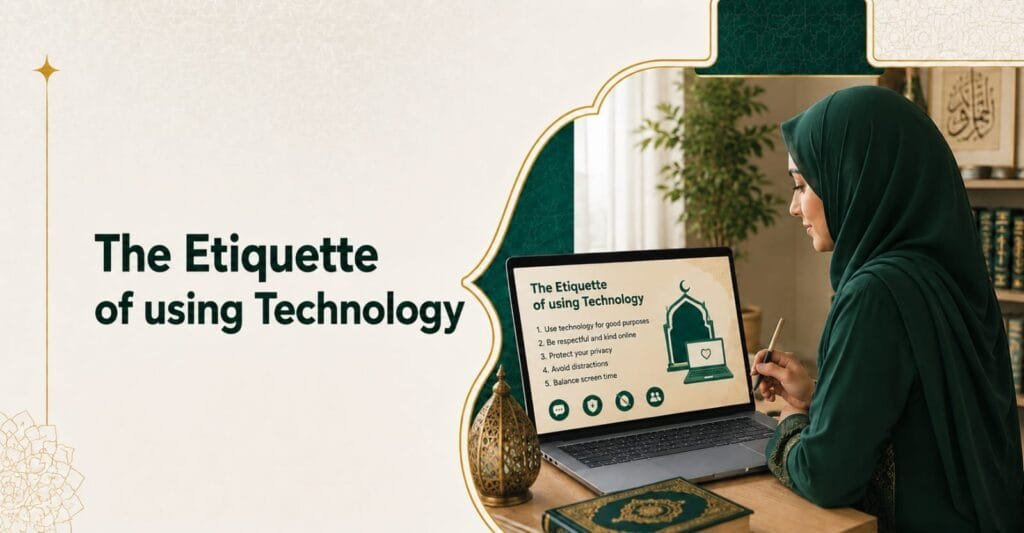
Digital Adab: The Ethics of Technology, Privacy, and Honesty in Islam
Imagine picking up your smartphone, opening a laptop, or stepping into an online exam room. Within milliseconds, you are connected to a vast, invisible digital universe. Technology has given us unprecedented power to communicate, acquire knowledge, and learn remotely across borders. Yet, behind the flat glass screens of our devices lies a major spiritual test: What happens to our character (Adab) when no one human is watching us?
In our hyper-connected, digital world, the temptation to take shortcuts, cheat on online assignments, or peek into someone else’s private messages is just a click away.
Over fourteen centuries ago, Islam established a timeless, comprehensive ethical framework that applies perfectly to the screen age: The Etiquette of Digital Conduct (Adab al-Taqniyyah), built on the absolute prohibitions of Cheating (Ghash) and Spying (Tajassus).
For Muslim families and students in the diaspora, practicing these ethics is not just about following rules. It is an active exercise in internal integrity, cultivating Muraqabah (mindfulness of Allah’s presence), and preserving a noble, trusted character online and offline.
1. The Linguistic Anatomy: Deconstructing Ghash and Tajassus
To appreciate why Islam takes such a firm stand against cheating and invading privacy, we must look directly at the classical Arabic root DNA of both concepts.
🔹 The Concept of Ghash (غَشّ – Cheating / Fraud)
The word Ghash (غَشّ) comes from a root that literally means to conceal impurity under a deceptively pure surface, to present something false as true, or to mislead through hidden defect.
In modern digital contexts, Ghash includes copying answers during online tests, using unauthorized AI tools to write assignments while pretending it is your own work, or plagiarizing content without credit.
The Prophet Muhammad (ﷺ) delivered a universal, uncompromising principle when he caught a merchant hiding wet grain beneath dry grain:
“Whoever cheats us is not one of us.” (Sahih Muslim)
   [ External Appearance: High Marks / Clean Work ] ───► Deceptive Surface
                        │
                        ▼  (The Reality of Ghash)
   [ Internal Reality: Copied / Stolen Effort ]      ───► Destroys Divine Barakah & Integrity
🔸 The Concept of Tajassus (تَجَسُّس – Spying / Invasion of Privacy)
The word Tajassus (تَجَسُّس) comes from the root J-S-S (ج-س-س), which literally means to probe with the fingers, to search out hidden wounds, or to pry into what is meant to be concealed.
In the digital world, Tajassus occurs when someone reads a friend’s private text messages without permission, hacks into accounts, listens in on private video calls, or stalks someone’s private online footprint to find their flaws.
Allah issues an explicit divine prohibition in the Quran:
“O you who have believed, avoid much negative assumption… And do not spy (Wa la tajassasu) nor backbite one another.” (Surah Al-Hujurat, 49:12)
2. The Spiritual Architecture: Cultivating Muraqabah in the Screen Age
When a student sits in front of a computer for a remote exam or holds a smartphone in a private room, human supervision is often absent. This is where the core Islamic concept of Muraqabah (مُرَاقَبَة) — Divine Mindfulness becomes the ultimate cognitive engine.
                  [ The Digital Environment ]
                              │
          ┌───────────────────┴───────────────────┐
          ▼                                       ▼
  [ External Control ]                    [ Internal Muraqabah ]
  Webcams, password locks,                Consciousness that Allah sees
  and proctoring software.                every keystroke and intent.
The classical scholars defined Muraqabah as the deep realization that Allah (Al-Raqeeb, The All-Watcher) sees your hidden thoughts and actions just as clearly as your public ones. When a child internalizes Muraqabah:
- They close alternate browser tabs during a test—not out of fear of getting caught, but out of love and respect for Allah.
- They put down a sibling’s unlocked phone without reading their private chats, knowing that respecting privacy is an act of worship.
3. Practical Sunnah Steps for Healthy Digital Ethics at Home
Teaching our children digital Adab, honesty, and privacy is one of the most vital life skills for the 21st century:
- The Oath of Honest Effort: Teach children that an authentic $70\%$ earned through honest individual effort carries infinitely more Barakah (divine blessing) and real skill than a fraudulent $100\%$ obtained through cheating.
- Respecting Digital Boundaries (Amanah): Establish a strict household rule: Every device is a trust (Amanah). We never unlock someone else’s phone, look at their open screens, or share their private pictures and messages without explicit permission.
- The “Would You Say It in Person?” Test: Train youth to evaluate their online comments, messages, and posts against a simple ethical filter: “If the Prophet (ﷺ) were in the room, or if I had to say this face-to-face, would I still send it?”
Engineering Digital Excellence at Esraa Quran & Arabic Hub
At Esraa Quran & Arabic Hub, we are deeply committed to utilizing modern technology to connect students with sacred knowledge, while upholding the highest standards of Islamic ethics and character (Adab).
During our specialized 1-on-1 private sessions, our highly proficient and expert instructors:
- Model transparent, honest, and respectful digital interactions in every lesson.
- Guide students to understand the deeper Quranic values behind honesty, privacy, and personal responsibility.
- Empower young Muslims in the diaspora to use technology as a tool for personal elevation, academic excellence, and noble character.
Esraa Quran & Arabic Hub
Connecting Hearts to the Divine Revelation, Wherever You Are.
📩 Contact us at: info@esraaquranarabichub.com