
The Etiquette of Public Cleanliness in Islam
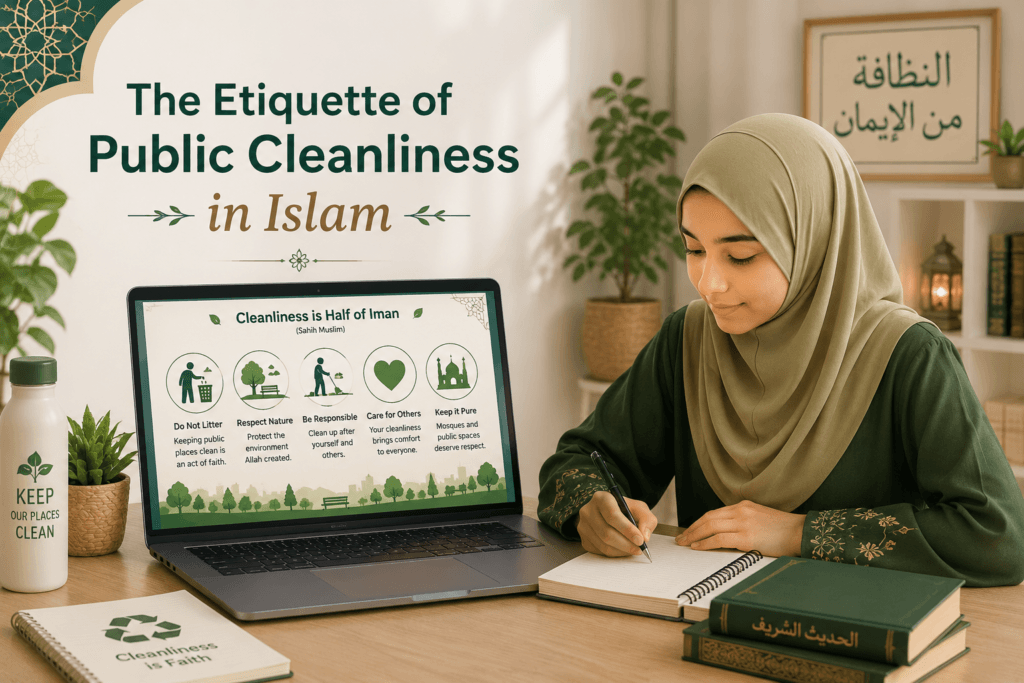
Imagine walking through a bustling city park, stepping along a neighborhood sidewalk, or sitting in a public plaza in London, New York, or Sydney. Everywhere you look, you notice discarded coffee cups, overflowing trash bins, or neglected public pathways. In our modern, fast-paced societies, public spaces are frequently treated as “no man’s land”—areas where personal responsibility ends the moment we step outside our own front doors.
Yet, over fourteen centuries ago, Islam completely dismantled this mental boundary, establishing a revolutionary social code: The Etiquette of Public Cleanliness in Islam (Adab al-Nadhafah al-Ammah).
For Muslim families raising children in the diaspora, understanding the Islamic etiquette of public cleanliness is not just a civic duty. It is a profound, active expression of faith (Eman), a sanctuary of civic pride, and a living form of Dawah that reflects the beauty of prophetic character to the world around us.
1. The Linguistic Anatomy of Nadhafah: Cleanliness as Spiritual DNA
To understand why public cleanliness is so deeply woven into Islamic law (Shariah), we must look directly at its classical Arabic root DNA.
The Prophet Muhammad (ﷺ) delivered a foundational axiom that every Muslim child learns early in life: “Tahoor (Purity/Cleanliness) is half of faith.” (Sahih Muslim).
In classical Arabic syntax, Nadhafah (نَظَافَة) comes from a root that means to cleanse, purify, and free something from all spots, stains, or harmful elements. Unlike basic secular hygiene, which is often motivated by aesthetics or health regulations, Nadhafah in Islam is a spiritual state.
   [ Secular Cleanliness ]  ───► Driven by external laws, appearance, or personal convenience
               │
               ▼
   [ Prophetic Nadhafah ]   ───► Driven by internal Eman, viewing every public space as a place of worship
Because a Muslim views the entire earth as a potential place of prayer—as the Prophet (ﷺ) declared: “The earth has been made for me a place of worship and a means of purification” (Sahih al-Bukhari)—every public street, park, and sidewalk carries a sacred status. Damaging or polluting a public space is directly defiling a space created for divine remembrance.
2. The Prophetic Blueprint: Removing Harm as an Act of Worship
Long before modern environmental campaigns, the Prophet Muhammad (ﷺ) codified public cleanliness as a direct, measurable branch of faith. He outlined a practical architecture governing how a believer interacts with communal spaces:
- Removing Harm is Charity (Sadaqah): The Prophet (ﷺ) stated: “Faith has sixty or seventy-something branches… and the lowest of them is removing a harmful object from the road.” (Sahih Muslim). Picking up a piece of litter, moving a sharp stone, or clearing a fallen branch off a public pathway is not a menial task—it is an active act of worship that writes charity into your record of deeds.
- The Sin of Polluting Public Spaces: The Prophet (ﷺ) explicitly warned against polluting areas where people gather, rest, or walk. He warned his companions: “Guard against the two things that incur curses.” They asked, “What are those two things?” He replied: “Relieving oneself in the paths people use or in their shade.” (Sahih Muslim). This strict prohibition extends to throwing trash, spitting, or creating unsanitary hazards in public parks, bus stops, and recreational spots.
- The Right of the Road (Haqq al-Tariq): When the Prophet (ﷺ) discussed the etiquette of sitting in public pathways, he emphasized the “Rights of the Road.” Among these rights is keeping the road clean, safe, and free from physical or emotional harm for everyone who passes by (Sahih al-Bukhari).
3. Practical Steps to Cultivate Public Cleanliness in the Modern Home
Teaching our children the etiquette of public cleanliness in Islam is one of the most effective ways to nurture deep civic responsibility and emotional maturity:
- The “Leave It Cleaner” Habit: Train children that whenever they visit a public park, beach, or playground, they should leave the area cleaner than they found it. Challenge them to pick up three extra pieces of litter before leaving, reminding them that each item cleared is an act of Sadaqah.
- Pocketing Waste: Teach children never to drop even the smallest candy wrapper on the ground, regardless of whether a trash bin is nearby. Encourage them to hold onto their trash or keep it in their pockets or bags until they find a proper disposal bin.
- Caring for Shared Spaces: Whether it is the local mosque, a school hallway, or a community center, teach children to take pride in maintaining shared facilities. Washing your hands neatly without splashing water all over the sink counter is a subtle, beautiful reflection of prophetic Adab.
Nurturing Civic Excellence at Esraa Quran & Arabic Hub
At Esraa Quran & Arabic Hub, we firmly believe that learning the Quran and classical Arabic should directly translate into radiant, living character (Adab). We do not confine Islamic education to academic memorization; we build confident, compassionate, and responsible leaders.
During our specialized 1-on-1 private sessions, our highly proficient and expert instructors guide your child through the Seerah, unpacking the profound social ethics of the Prophet (ﷺ) and demonstrating how a Muslim should carry themselves in public. We empower young Muslims in the diaspora to become beacons of cleanliness, dignity, and civic excellence within their Western communities.
🌟 Bring This Lesson to Life in Your Home! (Free Printable Posters)
To help your children visualize, track, and practice the beautiful Prophetic steps of caring for public spaces and environmental care, we have designed a collection of stunning, premium educational posters—crafted beautifully in our signature emerald-and-gold digital style.
You can download these high-resolution visual guides from our social media platforms for FREE. Simply print them out and display them in your child’s study corner or near the front door to serve as a joyful daily reminder for spreading peace, cleanliness, and responsibility wherever they go!
- 👉 [Click Here to Download Your Free Posters on Facebook & Instagram]
- 👉 [Book a 100% Free Trial Private Session for Your Child Now] — Give your child the opportunity to step into a beautiful, structured, and visually engaging online learning space that transforms classical knowledge into living, confident character.
Esraa Quran & Arabic Hub
Connecting Hearts to the Divine Revelation, Wherever You Are.
📩 Contact us at: info@esraaquranarabichub.com