
The Etiquette of Animal Welfare in Islam: The Prophetic Blueprint of Universal Mercy
Imagine standing under the scorching heat of a desert sun. You feel completely parched, with a throat so dry it burns. You finally find a deep well, climb down with immense effort, and drink your fill. As you climb back up to gasp for fresh air, you notice a dog panting heavily next to the mud. It desperately licks the damp earth to soothe its agonizing thirst.
Do you walk away to prioritize your own journey? Or do you climb back down into the dark well to help this creature?
In a famous narration, the Prophet Muhammad (peace be upon him) told his companions about a traveler who chose to help. He filled his leather shoe with water, held it between his teeth as he climbed up, and quenched the dog’s thirst.
Allah appreciated his act, forgiven his sins, and admitted him into Paradise (Sahih al-Bukhari). When the companions asked if serving animals yields a spiritual reward, the Prophet delivered a groundbreaking axiom: “There is a reward for serving every living being with a moist liver.”
Reclaiming the authentic animal welfare in islam offers a transformative tool for families raising children in a modern world. It reveals that mercy in Islam is not an exclusive club for humans. Instead, it acts as a sweeping cosmic mandate that shapes the soul of a believer.
1. The Linguistic Anatomy of Rahmah: A Mandate Over All Creation
To understand the foundational status of animal care in Islamic law, we must examine the core vocabulary of the Quran. Allah defined the entire mission of the Prophet Muhammad through a single comprehensive word: Rahmah (Mercy). Allah states:
“And We have not sent you, [O Muhammad], except as a mercy to the worlds.” — Surah Al-Anbiya 21:107
In classical Arabic grammar, the word used for worlds is Al-Alameen. This plural form encompasses everything outside of Allah: the world of humans, jinn, plants, and explicitly, animals.
A Unified Universal Mission
Islamic teachings organize this universal mission into two harmonious realms:
- The Human World: Guided through justice, equity, and moral brotherhood.
- The Animal World: Protected through strict divine rights, inherent dignity, and active care.
Animals are not unfeeling objects or mere economic commodities in Islamic psychology. The Quran elevates their spiritual status, declaring them to be conscious communities that worship their Creator: “And there is no creature on the earth or bird that flies with its wings except that they are communities like you” (Surah Al-An’am 6:38).
2. The Prophetic Architecture: Strict Rights and Emotional Sensitivity
Long before modern nations established societies for animal rights, the Prophet Muhammad instituted strict legal boundaries regarding how humans interact with living creatures. The prophetic model outlines a sophisticated framework of animal welfare in islam:
The Sin of Starvation and Confinement
The Prophet warned his companions of a woman whom Allah punished in the Hellfire because of a cat (Sahih al-Bukhari). She confined the cat, neither feeding it nor letting it free to hunt, until it died of starvation. Confinement without adequate physical and emotional care represents a major spiritual transgression.
The Prohibition of Psychological Cruelty
The companion Ibn Mas’ud narrated that while traveling, some companions took two nestling birds from their nest. The mother bird began flapping her wings in deep distress. When the Prophet returned, he was instantly moved by her grief and demanded: “Who has distressed this bird by taking her young? Return her children to her!” (Sunan Abi Dawud).
The Etiquette of Labor and Burden
The Prophet once entered a garden and saw a camel weeping with tears flowing from its eyes. He approached the animal, gently wiped away its tears, and strictly admonished its young owner: “Do you not fear Allah regarding this beast which Allah has put in your possession? Indeed, it has complained to me that you keep it hungry and burden it with endless work!” (Sunan Abi Dawud).
3. Practical Sunnah Steps for Animal Care at Home
Teaching our children these prophetic etiquettes softens their hearts and grounds their character (Adab) in empathy:
- The Shared Water and Food Routine: Train children to place a simple bowl of fresh water and birdseed on window sills or balconies. Teach them that every bird drinking from that bowl writes an act of continuous charity (Sadaqah) into their record of deeds.
- Respecting the Dignity of Living Spaces: Teach children never to destroy anthills or insect nests out of boredom. The Prophet strictly forbade destroying anthills or using fire to clear out pests unnecessarily.
- Gentleness with Household Pets: Treat household pets, such as cats, as guests of honor. Children must learn physical boundaries—never pulling tails, disrupting sleep, or treating animals like inanimate toys.
Nurturing Holistic Character at Esraa Hub
At Esraa Quran & Arabic Hub, we never isolate Islamic education from the natural world. True understanding of the Quran builds a balanced individual who feels deeply connected to all of Allah’s creation.
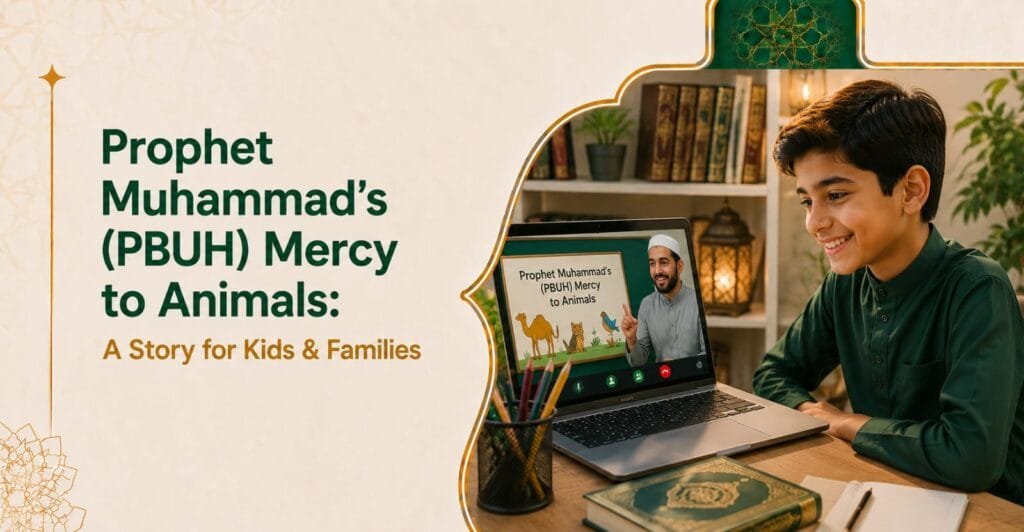
During our specialized 1-on-1 private sessions, our expert instructors guide your child to discover inspiring stories of mercy from the Seerah. We decode the linguistic roots of creation in the Quran and help them embrace their role as a Khalifah (trustee) on this earth. We build a visually stimulating digital learning space that empowers young Muslims in the diaspora to carry themselves with immense compassion and active character through our tailored [programs].
🌟 Bring This Lesson to Life in Your Home! (Free Printable Posters)
To help your children visualize and practice these prophetic steps of showing mercy to animals, we designed a collection of premium educational posters. These visual guides reflect our signature emerald-and-gold digital brand identity.
You can download these high-resolution checklists from our social media platforms completely for FREE. Print them out and display them in your child’s study corner as a joyful daily reminder for spreading universal Rahmah:
- 👉 [[Click Here to Download Your Free Posters on Facebook & Instagram]]
- 👉 [[Book a 100% Free Trial Private Session for Your Child Now]] — Give your child the opportunity to step into a structured, engaging online learning space that transforms classical knowledge into living character.
📩 Contact us at: info@esraaquranarabichub.com