
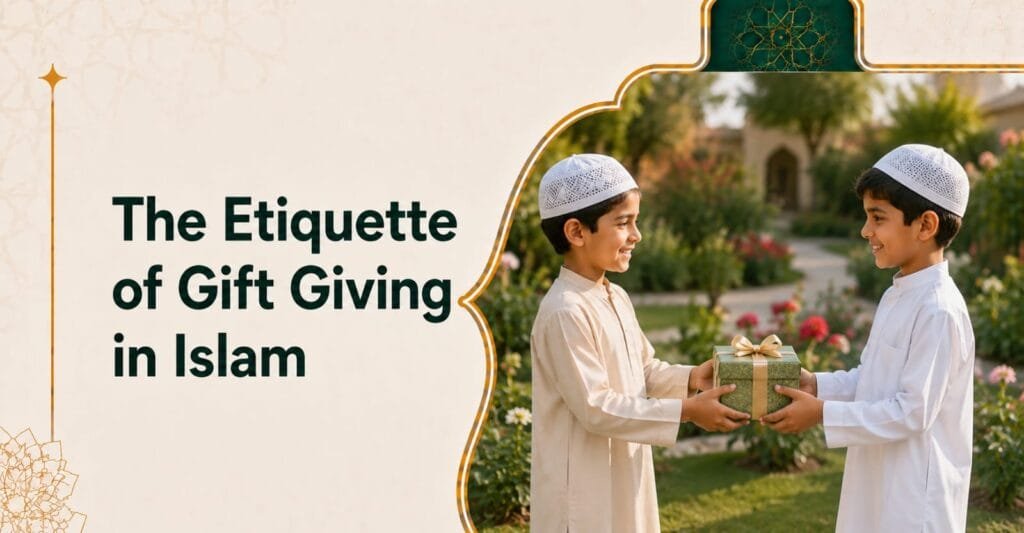
The Etiquette of Gift Giving in Islam: The Meaning Behind “Tahadu Tahabu”
Imagine scrolling through your favorite social media app or stepping into a modern shopping mall. You are instantly bombarded by algorithmic notifications and complex marketing campaigns designed to do one thing: push you to consume. In our highly transactional, fast-paced Western environments, the act of giving has often been commercialized, flattened into seasonal compliance, or driven by a subconscious expectation of “quid pro quo”—I give to you, so you must owe me.
Yet, embedded deep within the classical traditions of Islam is a completely different, highly sophisticated psychological blueprint for giving. It is a system that does not view a gift as a commercial transaction, but as a somatic and spiritual conduit engineered to dissolve social friction, heal unseen emotional wounds, and stitch hearts together.
For families navigating the hyper-individualistic culture of the West, reclaiming the etiquette of gift giving in Islam is a transformative tool. It shifts our relationships from shallow digital interactions into deep, unshakeable bonds of love.
The Linguistic Anatomy of “Tahadu Tahabu”
To understand the profound psychological mechanics of gift exchange in Islam, we must bypass modern translations and look directly at its classical Arabic root DNA. The universal prophetic formula for giving is captured in the famous, compact statement of the Prophet Muhammad (ﷺ): “Tahadu Tahabu” (تَهَادَوْا تَحَابُّوا).
When we look at the structural morphology of these two words, a breathtaking psychological reality unfolds:
- The Act—Tahasu: This word originates from the root H-D-Y (ه-د-ي), which is the exact same root word used for Hidayah (guidance). In classical syntax, a Hadiyyah (gift) is named so because it is a tangible object that guides or directs the recipient’s heart toward the sender.
- The Result—Tahabu: Both verbs are engineered using the Arabic grammatical form Wazn Tafa’ul (تَفَاعُل). This specific linguistic scale dictates compulsory reciprocity and mutual participation.
The Prophet (ﷺ) did not say “give gifts so the other person loves you” (one-way). He used a grammatical structure that implies: the moment the gift is exchanged, a mutual loop of affection is instantly generated between both parties.
How the Sunnah of Hadiyyah Builds Loving Hearts
Because Islam fuses elevated spiritual ideals with practical social engineering, the Prophet (ﷺ) explicitly highlighted the neurological impact of a gift. He stated: “Exchange gifts, as that will remove ill-will from the hearts.” (Sunan At-Tirmidhi).
In any human relationship—whether between parents and children, spouses, or friends within a community—small frictions, misunderstandings, and silent resentments naturally accumulate over time. The Sunnah of Hadiyyah teaches us that a gift acts as a solvent for these frictions. It doesn’t matter if the gift is monumentally expensive or beautifully simple; the act of giving signals to the recipient’s brain: “You were present in my mind when you were absent from my sight.”
Cultivating Prophetic Etiquette in the Digital Age
For children and young adults growing up behind screens in the diaspora, practicing Islamic etiquette through gift-giving is a vital tool for building character (Adab):
- Defeating Entitlement: Modern digital culture trains children to constantly receive. Teaching a child to thoughtfully select, wrap, and give a gift to a teacher, a classmate, or a sibling shifts their mindset from a consumer to a contributor.
- Learning the Etiquette of Acceptance: Prophetic etiquette teaches us that accepting a gift with profound gratitude, making Dua for the giver, and never belittling a small gesture is just as sacred as the act of giving itself.
Engineering Emotional Intelligence at Esraa Quran & Arabic Hub
At Esraa Quran & Arabic Hub, we do not treat our online classes as distant, robotic data streams; we treat them as warm, living communities anchored in prophetic manners.
During our highly specialized 1-on-1 private sessions, our highly proficient and expert instructors actively model these values. We celebrate our students’ milestones, reward their consistency, and teach them the linguistic beauty behind classical expressions of gratitude. We build a space where your child learns that the ultimate gift is the knowledge of the Quran itself, inspiring them to carry themselves with generosity, confidence, and radiant kindness.
🌟 Bring This Lesson to Life in Your Home! (Free Printable Posters)
To help your children practice the beautiful etiquettes of giving and receiving gifts with joyful sincerity, we have designed a collection of stunning, premium educational posters—matching our signature emerald-and-gold digital style.
You can download these high-resolution visual checklists from our social media platforms for FREE. Print them out and display them in your home or study corner to serve as a colorful, creative guide for practicing prophetic generosity every single day.
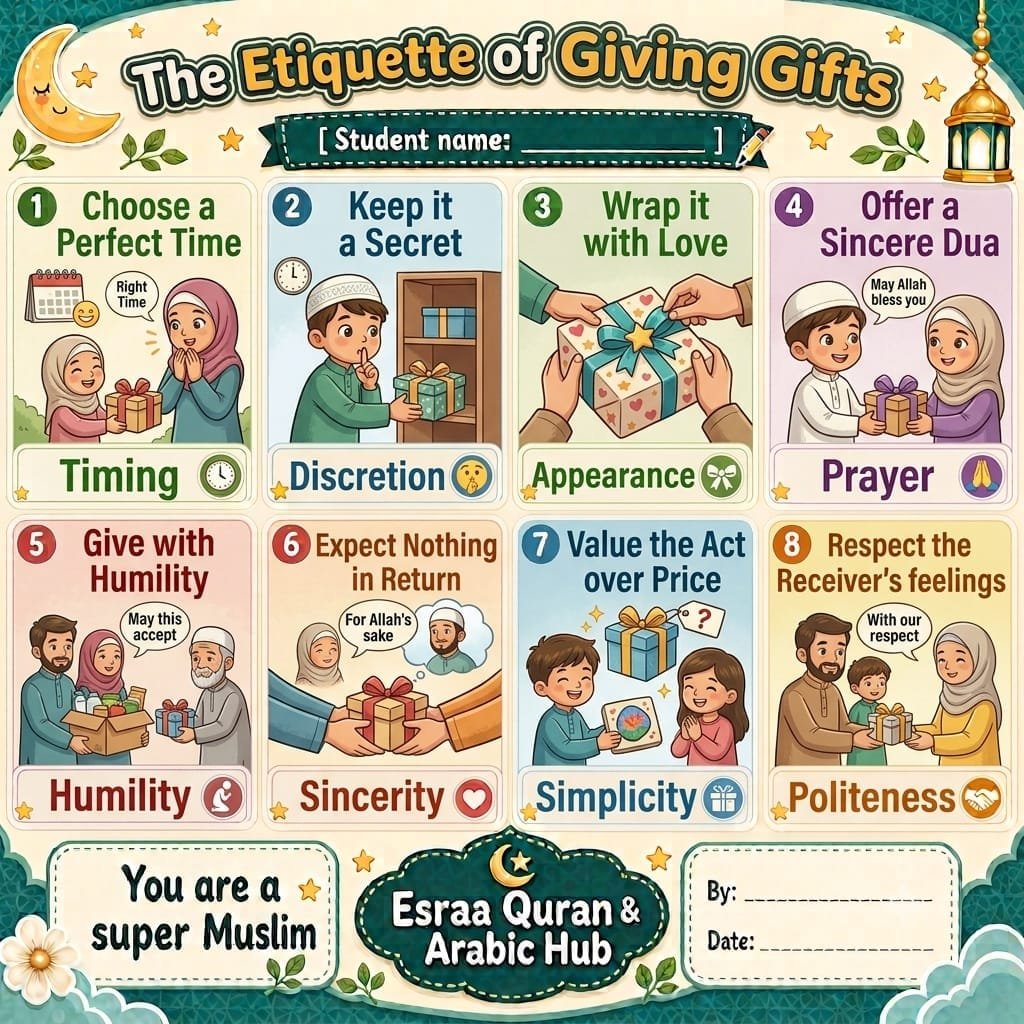
- 👉 [Click Here to Download Your Free Posters on Facebook & Instagram]
- 👉 [Book a 100% Free Trial Private Session for Your Child Now] — Give your child the opportunity to experience a beautiful, structured, and visually engaging online learning space that connects classical Arabic grammar to real, lived character.
Esraa Quran & Arabic Hub Connecting Hearts to the Divine Revelation, Wherever You Are. 📩 Contact us at: info@esraaquranarabichub.com