
The Concept of Tawbah in Islam: Turning Mistakes into Spiritual Growth
Imagine traveling down a highway with a state-of-the-art GPS system. You make a wrong turn, missing your exit entirely. The GPS doesn’t lock up, crash, or begin yelling at you for your mistake. Instead, it immediately and calmly begins calculating a path back, displaying a simple directive on the screen: Rerouting.
In the journey of our spiritual lives, we constantly make wrong turns. As human beings, we are hardwired to slip, lose focus, and make mistakes. Yet, many Muslims—especially young people navigating the high-pressure environments of the West—carry a deep, subconscious anxiety that a single spiritual detour permanently ruins their standing with the Creator.
The remedy to this paralyzing anxiety lies in uncovering the stunning linguistic architecture and emotional warmth of a single, foundational word: Tawbah (التَّوْبَة). When unpacked through the precision of classical Arabic grammar, Tawbah stops being a heavy, shame-filled ritual of guilt and transforms into a liberating, beautiful system of divine rerouting.
1. The Linguistic Anatomy: The Beautiful Act of Returning
To understand the psychological relief hidden within Tawbah, we have to strip away centuries of cultural baggage and look directly at its classical Arabic root DNA.
The word Tawbah comes from the root T-W-B (ت-و-ب). In the classical lexicon, Taaba carries a beautifully simple, literal definition: to return, to come back home, or to retreat from a dangerous path.
When this root is applied in Islamic spiritual psychology, it creates a fascinating, reciprocal relationship between the servant and the Creator, governed by two magnificent names of Allah:
- The Servant’s Return: When a human being repents, they are making a Tawbah—actively returning their heart back to its original fitrah (natural state of purity) after wandering off into the wilderness of distraction or mistake.
- The Creator’s Embrace—At-Tawwab (التَّوَّاب): This is where the grammar becomes breathtaking. At-Tawwab is an intensive form (Sighat al-Mubalaghah), meaning The One who effortlessly, relentlessly, and repeatedly returns.
   [ The Servant's Action: Tawbah ] ───► A conscious decision to TURN BACK from a wrong path
                 │
                 ▼
   [ The Divine Reaction: At-Tawwab ] ───► Allah TURNS BACK to the servant with immediate mercy
                 │
                 ▼
   The Reality: Tawbah is not a courtroom trial; it is an open-door policy of returning home.
When you say you are making Tawbah, you aren’t standing before a ruthless judge waiting for a sentence. You are a traveler who wandered into the dark, turning around to find that the Creator of the universe is already turning toward you with open arms, ready to erase the distance as if it never existed.
2. Breaking the Stagnation: The Three-Step Calibration of Sincere Tawbah
Because the spiritual framework of Islam is entirely practical, Tawbah is treated as an active project of self-recalibration, not just a vague emotional feeling. The classical scholars outlined three precise steps to ensure that a return to Allah is structurally sound and effective:
- Immediate Regret (An-Nadam): An honest, internal acknowledgment that the detour was harmful to the soul. The Prophet Muhammad (ﷺ) beautifully compressed this entire science into three words: “Regret is repentance.” (Sunan Ibn Majah).
- Cessation (Al-Iqla’): Actively stepping off the path of the mistake in the present moment. It means hitting the brakes on the negative habit.
- The New Blueprint (Al-’Azm): A firm, conscious intention to design a lifestyle that avoids falling back into that specific loop.
Without these active steps, Tawbah becomes a hollow linguistic expression. True repentance doesn’t demand human perfection; it simply demands an authentic change in direction.
3. The Ultimate Metamorphosis: Turning Flaws Into Fuel
The psychological weight of past mistakes can often trap an online student or a young Muslim in a state of spiritual paralysis, making them feel unworthy of reading the Quran or entering a space of learning.
This is where the ultimate miracle of Tawbah unfolds. Allah does not just erase the record of a returned servant; He entirely restructures the past. The Quran unveils this mind-blowing spiritual law in Surah Al-Furqan:
“Except for those who repent, believe, and do righteous work. For them, Allah will replace their evil deeds with good deeds. And ever is Allah Forgiving and Merciful.” (Surah Al-Furqan, 25:70)
Think about the cognitive weight of this verse. Through the technology of sincere Tawbah, the Divine system takes the energy of your past mistakes, deletes the negative consequences, and transmutates those exact dark spots into mountains of light on your scale of good deeds. Your past shortfalls literally become the fuel that accelerates your future spiritual growth.
Cultivating a Culture of Hope at Esraa Quran & Arabic Hub
At Esraa Quran & Arabic Hub, we realize that teaching children and young adults in the West requires moving away from frameworks of constant guilt, shifting instead toward an intelligent, inspiring framework of hope and growth.
When a student struggles with an articulation point, makes mistakes in their memorization, or slips in their daily consistency, our highly proficient and expert instructors don’t push them toward frustration. We use these moments as living classrooms. We teach our students that making mistakes is part of the human design, and that learning how to pivot, reset, and return to the text with a smile is the highest form of Adab (etiquette) with Allah. By weaving linguistic precision with profound emotional security, we build confident, resilient minds capable of practicing their faith with absolute clarity and deep joy.
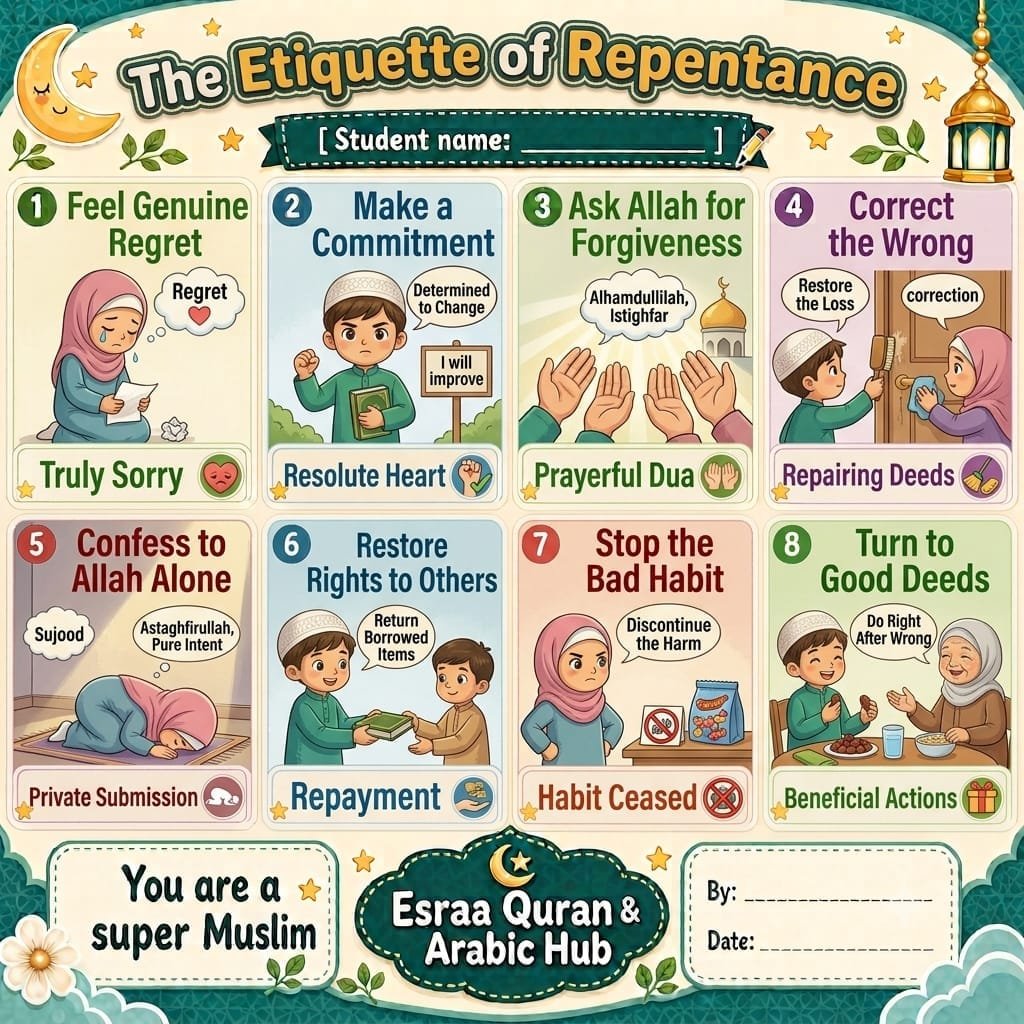
🌟 Bring This Lesson to Life in Your Home! (Free Printable Posters)
To help your children visualize Tawbah as a hopeful, positive roadmap rather than a source of anxiety, we have designed a collection of beautiful, premium educational posters based on this topic—matching our signature emerald-and-gold digital style.
You can download these high-resolution visual guides from our social media platforms for FREE. Print them out and place them in your child’s study space or bedroom to serve as a daily, encouraging reminder that the door to return to Allah is always wide open.
- 👉 [Book a 100% Free Trial Private Session for Your Child Now] — Let your child experience a beautiful, uplifting, and expert-led 1-on-1 online environment where mistakes are transformed into steps of spiritual growth.
Esraa Quran & Arabic Hub Connecting Hearts to the Divine Revelation, Wherever You Are. 📩 Contact us at: info@esraaquranarabichub.com